


[Sep 11, 2025] Uplift Your EMEA-Advanced-Support Exam Marks With The Help of EMEA-Advanced-Support Dumps
Use Fortinet EMEA-Advanced-Support Dumps To Succeed Instantly in EMEA-Advanced-Support Exam
NEW QUESTION # 11
What happens when a router receives a packet for forwarding with a TTL value of 1?
- A. It increments it and passes it on to the next router
- B. The TTL is decreased to 0, the packet is dropped and an ICMP message is sent to the transmitting IP
- C. It decreases the value to 0 and then forwards it
- D. The packet is only forwarded through the router to a locally attached network
Answer: B
Explanation:
When a router, such as a FortiGate, receives a packet with a TTL (Time to Live) of 1, it decrements the TTL to 0, drops the packet, and sends an ICMP Time Exceeded message to the source IP. This prevents infinite loops in routing. Option A is incorrect as TTL is decremented, not incremented; B and D are incorrect as the packet is not forwarded when TTL reaches 0. Exact extract: "When a packet's TTL reaches 1, the router decrements it to 0, drops the packet, and sends an ICMP Time Exceeded message to the source IP address to prevent routing loops."
NEW QUESTION # 12
A firewall receives an out-of-order packet in a TCP session after the FIN/ACK and the packet is dropped as expected. What parameter can be changed to prevent such drops?
- A. TCPMSS
- B. TCP time-wait timer
- C. TCP close-wait timer
- D. Enable TCP option
Answer: B
Explanation:
Out-of-order packets after FIN/ACK indicate a packet arriving in the TIME_WAIT state, where the session is closing. The TCP time-wait timer controls how long the firewall keeps the session in the TIME_WAIT state to handle late packets. Increasing this timer allows the firewall to accept such packets instead of dropping them. Close-wait timer relates to a different state, TCPMSS affects packet size, and "Enable TCP option" is not a standard parameter. Exact extract: "The TCP time-wait timer determines how long a session remains in the TIME_WAIT state to handle out-of-order or retransmitted packets after FIN/ACK... Adjusting this timer can prevent drops of late-arriving packets."
NEW QUESTION # 13
How does a stateful firewall control a TCP session?
- A. TCP source ports are used to control the session
- B. TCP destination ports are used to control the session
- C. TCP ack numbers are used to control the session
- D. TCP sequence numbers and TCP flags are used to control the session
Answer: D
Explanation:
A stateful firewall, like FortiGate, tracks TCP sessions by maintaining a state table that includes TCP sequence numbers and flags (e.g., SYN, ACK, FIN) to monitor the connection's lifecycle (establishment, data transfer, termination). This ensures proper session handling, detecting out-of-order packets or invalid states.
Source and destination ports identify the session but don't control its state, and ACK numbers alone are insufficient. Exact extract: "Stateful inspection tracks TCP sessions using sequence numbers and TCP flags (SYN, ACK, FIN, etc.) to ensure packets are valid and part of an established session... FortiGate maintains a state table to monitor the TCP connection states."
NEW QUESTION # 14
Which statement is true about IPsec VPNs and SSL VPNs?
- A. All of the above
- B. Both SSL VPNs and IPsec VPNs are standard protocols
- C. SSL VPN creates a HTTPS connection. IPsec does not
- D. Either a SSL VPN or an IPsec VPN can be established between an end-user workstation and a FortiGate device
Answer: A
Explanation:
Both SSL VPN and IPsec VPN are standard protocols supported by FortiGate devices for secure remote access. SSL VPN typically uses HTTPS (TCP port 443) for encrypted communication, while IPsec uses protocols like IKE and ESP. Both can be configured between an end-user workstation (e.g., via FortiClient) and a FortiGate device, supporting various authentication methods. All options are correct, making D the correct answer. Exact extract: "SSL VPN technology uses the standard SSL/TLS protocol to provide a secure connection to the FortiGate unit. The FortiGate SSL VPN can be configured to use HTTPS..." and "IPsec VPNs use standardized protocols like IKE and ESP to create secure tunnels... FortiClient supports both IPsec and SSL VPN connections to FortiGate devices for remote access."
NEW QUESTION # 15
Which protocols are used by an email client to retrieve emails?
- A. IMAP4
- B. SNMP
- C. POP3
- D. SMTP
Answer: A,C
Explanation:
Email clients use POP3 (Post Office Protocol) and IMAP4 (Internet Message Access Protocol) to retrieve emails from a server. POP3 downloads emails and typically removes them from the server, while IMAP4 allows synchronized access. SMTP is used for sending emails, and SNMP is for network monitoring, not email retrieval. Exact extract: "Email clients use POP3 or IMAP to retrieve email messages from a mail server... IMAP allows users to access and manage email directly on the server, while POP3 typically downloads messages to the client."
NEW QUESTION # 16
Which of the following is a network monitoring protocol?
- A. Telnet
- B. SNMP
- C. SSH
- D. RDP
Answer: B
Explanation:
SNMP (Simple Network Management Protocol) is specifically designed for monitoring and managing network devices, allowing administrators to query device status, performance metrics, and configure alerts for issues. It operates by using agents on devices that report to a central manager. In contrast, RDP is for remote desktop access, Telnet for unsecure remote command-line access, and SSH for secure remote access. SNMP is the standard protocol for network monitoring in Fortinet products like FortiGate, FortiSwitch, etc. Exact extract: SNMP enables administrators to monitor how devices are performing and make changes to network devices so that data moves through the network more efficiently. Simple Network Management Protocol (SNMP) enables you to monitor hardware on your network. The FortiSwitch SNMP implementation is read- only. Monitoring FortiAP with SNMP. You can enable SNMP directly on FortiAP by implementing a SNMPD daemon/subagent on the FortiAP side. The Simple Network Management Protocol (SNMP) allows you to monitor hardware on your network. You can configure the hardware, such as the FortiProxy SNMP agent.
NEW QUESTION # 17
How many layers does the OSI Model contain?
- A. 0
- B. 1
- C. 2
- D. 3
Answer: B
Explanation:
The OSI (Open Systems Interconnection) model consists of seven layers: Physical, Data Link, Network, Transport, Session, Presentation, and Application. This framework is used in Fortinet documentation to explain protocol operations. Options A, C, and D are incorrect as they do not match the standard OSI model.
Exact extract: "The OSI model defines seven layers for network communication: 1. Physical, 2. Data Link, 3.
Network, 4. Transport, 5. Session, 6. Presentation, 7. Application."
NEW QUESTION # 18
Which FortiGate feature allows for policy-based routing?
- A. Policy Routes
- B. Dynamic Routes
- C. Static Routes
- D. SD-WAN Rules
Answer: A
Explanation:
Policy Routes in FortiGate allow routing decisions based on criteria like source, destination, or service, overriding the default routing table. SD-WAN Rules (A) are for WAN optimization, Static Routes (C) are fixed, and Dynamic Routes (D) are protocol-based, not policy-based. Exact extract: "Policy Routes allow FortiGate to make routing decisions based on user-defined criteria, such as source/destination IPs or services, overriding standard routing."
NEW QUESTION # 19
Which of the following protocols would you expect a typical switch to support?
- A. OSPF
- B. STP
- C. SIP
- D. VLAN
Answer: B,D
Explanation:
Typical Layer 2 switches support STP (Spanning Tree Protocol) to prevent loops in redundant networks and VLANs (Virtual Local Area Networks) to segment traffic logically. OSPF is a Layer 3 routing protocol typically on routers, and SIP is for VoIP session initiation, not core switch functions. FortiSwitch supports STP variants like MSTP and VLAN tagging. Exact extract: MSTP supports multiple spanning tree instances, where each instance carries traffic for one or more VLANs (the mapping of VLANs to instances is configurable). These protocols include the Spanning Tree Protocol (STP), Multiple Spanning Tree Protocol (MSTP), and Per-VLAN Rapid Spanning Tree Protocol ( ... FortiSwitch supports Spanning Tree Protocol (STP), Multiple Spanning Tree Protocol (MSTP), and Per-VLAN Rapid Spanning Tree Protocol (RSTP).
Spanning Tree Protocol (STP) is a link-management protocol to enable a layer 2 loop-free topology. STP enables a network to have redundant paths for fault ... Go to WiFi & Switch Controller > FortiSwitch Ports.
Click a port row. Click the Native VLAN column in one of the selected entries to change the native VLAN.
NEW QUESTION # 20
Which parts of the IKE protocol below are responsible for authenticating the User (username/password) of a dialup IPsec tunnel? (Check all correct answers)
- A. IKEv1 Xauth
- B. IKEv2 EAP
- C. IKEv1 phase1
- D. IKEv1 phase2
- E. IKEv2 SA_INIT
Answer: A,B
Explanation:
For user authentication in dialup IPsec, IKEv1 uses XAuth (Extended Authentication) after Phase 1 for username/password. IKEv2 uses EAP (Extensible Authentication Protocol) for similar user auth. Phase 1 and SA_INIT are for peer auth, Phase 2 for child SA negotiation. Exact extract: XAuth increases security by requiring remote dialup client users to authenticate in a separate exchange at the end of phase 1. IPsec IKEv2 VPNs now support certificate authentication and EAP authentication at the same time from a dialup FortiClient. With the eap-cert-auth setting ... IPsec IKEv2 VPNs now support certificate authentication and EAP authentication at the same time from a dialup FortiClient. IPsec IKEv1 uses XAUTH for user authentication, and IPsec IKEv2 uses EAP for user authentication. Only EAP-TTLS is interoperable with LDAP. For LDAP based user ... In your scenario, the user cannot authenticate by providing both a PSK and their credentials (using one of multiple EAP methods).
NEW QUESTION # 21
Which of the following are request methods in HTTP?
- A. GET
- B. RETR
- C. HEAD
- D. LIST
Answer: A,C
Explanation:
HTTP defines standard request methods, including GET (retrieve a resource) and HEAD (retrieve headers only). LIST and RETR are not standard HTTP methods; RETR is used in FTP, and LIST is not a recognized method in either protocol. The original document incorrectly lists only A, omitting C. Exact extract: "HTTP supports several request methods, including GET, HEAD, POST, PUT, DELETE, etc... GET retrieves a resource, while HEAD retrieves only the headers without the body content."
NEW QUESTION # 22
Client is connected to firewall via link with MTU 1500 bytes, server is connected to firewall via link with MTU 1496 bytes. The firewall is rewriting both sender and receiver tcp-mss to 1450 bytes. What maximum size of IP packets are we going to see when client connects to server?
- A. 1500 bits
- B. 1496 bytes
- C. 1450 bytes
- D. 1450 bits
- E. 1500 bytes
- F. 1496 bits
Answer: C
Explanation:
The TCP MSS (Maximum Segment Size) defines the maximum TCP payload size, excluding headers. When the firewall sets MSS to 1450 bytes, the TCP segment size is limited to this value. For IP packets, the total size includes the TCP header (20 bytes) and IP header (20 bytes), so 1450 (MSS) + 20 (TCP) + 20 (IP) = 1490 bytes, which fits within both link MTUs (1500 and 1496 bytes). Thus, the maximum IP packet size is not limited by the link MTUs but by the MSS, adjusted for headers. Options C and F (bits) are incorrect units; A and B exceed the MSS limit. Exact extract: "The TCP MSS is adjusted to prevent fragmentation... FortiGate can rewrite the MSS in TCP SYN packets to ensure the total IP packet size (including IP and TCP headers) does not exceed the configured value."
NEW QUESTION # 23
What does the FortiGate 'set nat enable' command do in a firewall policy?
- A. Enables NAT for incoming traffic only
- B. Disables NAT for the policy
- C. Enables NAT for outgoing traffic
- D. Forces NAT to use a specific IP pool
Answer: C
Explanation:
The 'set nat enable' command in a FortiGate firewall policy enables Source NAT (SNAT) for outgoing traffic, typically rewriting the source IP to the FortiGate's interface IP or an IP pool. It does not disable NAT (B), force a specific pool (C), or limit to incoming traffic (D). Exact extract: "The 'set nat enable' command in a firewall policy enables Source NAT, rewriting the source IP address of outgoing traffic to the egress interface IP or a configured NAT pool."
NEW QUESTION # 24
In a FortiGate high availability (HA) cluster, what happens if the primary unit fails?
- A. The cluster is disabled, and traffic stops
- B. The cluster switches to active-passive mode
- C. A secondary unit takes over as the primary unit
- D. Traffic is rerouted through an external gateway
Answer: C
Explanation:
In a FortiGate HA cluster (active-active or active-passive), if the primary unit fails, a secondary unit automatically takes over as the primary, ensuring continuity of traffic with minimal disruption. Option A is incorrect as traffic continues, C is incorrect as the mode doesn't change post-failure, and D is unrelated. Exact extract: "In a FortiGate HA cluster, if the primary unit fails, a secondary unit is elected as the new primary, taking over all roles to maintain traffic flow and session continuity."
NEW QUESTION # 25
Which FortiGate feature mitigates DDoS attacks by limiting the rate of incoming connections?
- A. Web Filtering
- B. Application Control
- C. DoS Policy
- D. IPS Signature
Answer: C
Explanation:
FortiGate's DoS (Denial of Service) Policy limits the rate of incoming connections or packets to mitigate DDoS attacks, such as SYN floods, by setting thresholds for specific traffic types. IPS Signatures (B) detect specific attack patterns, Application Control (C) manages app usage, and Web Filtering (D) blocks URLs, none of which focus on rate limiting. Exact extract: "DoS policies protect against DDoS attacks by limiting the rate of incoming connections or packets, such as SYN floods, based on configured thresholds."
NEW QUESTION # 26
What is the purpose of the FortiGate 'diagnose debug flow' command?
- A. To monitor system performance metrics
- B. To troubleshoot routing table issues
- C. To show the packet flow through firewall policies
- D. To display real-time packet captures
Answer: C
Explanation:
The 'diagnose debug flow' command in FortiGate is used to troubleshoot how packets are processed through firewall policies, showing details like policy matching, NAT, and session handling. It helps identify why packets are allowed or dropped. Option A refers to packet sniffing, B to routing diagnostics, and D to performance monitoring, none of which are the primary function. Exact extract: "The diagnose debug flow command displays the packet flow through FortiGate, including policy matching, NAT, and session details, useful for troubleshooting traffic issues."
NEW QUESTION # 27
Firewall is performing stateful inspection for TCP traffic between Client 10.0.0.21 and Server 172.16.1.200.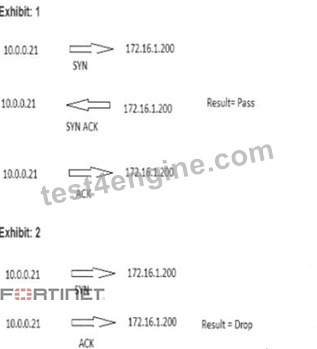
- A. The ACK was not supposed to be sent to client 10.0.0.21
- B. Three way handshake was not completed
- C. Traffic is Asymmetric and not allowed by the Firewall
- D. Traffic should be allowed
Answer: B
Explanation:
Stateful inspection requires a complete TCP three-way handshake (SYN, SYN-ACK, ACK) to establish a session in the firewall's state table. If the handshake is incomplete (e.g., missing ACK), the session is not established, and traffic is dropped. The question implies a stateful firewall scenario where traffic is blocked, likely due to an incomplete handshake. Asymmetric traffic (B) or incorrect ACK (A) are not indicated without further context, and C is incorrect if the handshake fails. Exact extract: "Stateful inspection ensures that a TCP three-way handshake is completed before allowing traffic... If the handshake is not completed, FortiGate drops the packets as invalid."
NEW QUESTION # 28
TCP protocol can be used for data delivery via multicast
- A. Yes
- B. No
Answer: B
Explanation:
TCP is a unicast, connection-oriented protocol that ensures reliable data delivery between two endpoints using sequence numbers and acknowledgments. Multicast, which sends data to multiple recipients, is supported by UDP, not TCP, due to TCP's requirement for a direct connection. Fortinet devices handle multicast traffic via UDP-based protocols like IGMP or PIM. Exact extract: "TCP is a unicast protocol that establishes a reliable connection between two devices... Multicast traffic, such as streaming or group communications, relies on UDP, as TCP does not support multicast delivery."
NEW QUESTION # 29
Which FortiGate log type records denied traffic events?
- A. Security Log
- B. Event Log
- C. System Log
- D. Traffic Log
Answer: D
Explanation:
Traffic Logs in FortiGate record all traffic events, including denied packets, with details like source, destination, and policy ID. Security Logs (B) cover UTM events, Event Logs (C) system events, and System Logs (D) hardware or system status, not specifically denied traffic. Exact extract: "Traffic Logs record all packet activity, including allowed and denied traffic, with details such as source/destination IPs, ports, and the firewall policy applied."
NEW QUESTION # 30
What are source and destination MAC addresses of an ARP request?
- A. The source MAC is that of the forwarding switch and destination of the targeted device
- B. The source MAC is that of the sending device and the destination of the targeted device
- C. The source MAC is that of the sending device and the destination MAC is a broadcast address
- D. The source MAC is that of the sending device and the destination is a multicast address
Answer: C
Explanation:
An ARP (Address Resolution Protocol) request is broadcast to resolve an IP address to a MAC address. The source MAC is the sender's MAC address, and the destination MAC is the broadcast address (FF:FF:FF:FF:
FF:FF) to reach all devices on the local network. Fortinet devices handle ARP for Layer 2 communication.
Options B, C, and D are incorrect as switches don't originate ARP requests, the target's MAC is unknown, and ARP uses broadcast, not multicast. Exact extract: "In an ARP request, the source MAC address is that of the sending device, and the destination MAC address is the broadcast address (FF:FF:FF:FF:FF:FF), sent to all devices in the local network segment."
NEW QUESTION # 31
......
Fortinet Dumps - Learn How To Deal With The Exam Anxiety: https://actualtests.test4engine.com/EMEA-Advanced-Support-real-exam-questions.html