


Try 100% Updated CKA Exam Questions [2024]
Pass CKA Exam - Real Questions and Answers
Linux Foundation Certified Kubernetes Administrator (CKA) program is a certification exam designed to test the knowledge of individuals in administering Kubernetes clusters. Kubernetes is an open-source container orchestration system that is used to automate the deployment, scaling, and management of containerized applications. The CKA program is an industry-recognized certification that validates the skills and knowledge of administrators, developers, and architects in working with Kubernetes.
NEW QUESTION # 35
Set CPU and memory requests and limits for existing pod name
"nginx-prod".
Set requests for CPU and Memory as 100m and 256Mi respectively
Set limits for CPU and Memory as 200m and 512Mi respectively
- A. kubectl get po
kubectl set resources po nginx-prod --
limits=cpu=200m,memory=512Mi --requests=cpu=100m,memory=256Mi
//Verify
kubectl describe po nginx-prod - B. kubectl get po
kubectl set resources po nginx-prod --
limits=cpu=200m,memory=512Mi --requests=cpu=100m,memory=256Mi
//Verify
kubectl top po
kubectl describe po nginx-prod
Answer: B
NEW QUESTION # 36
List the nginx pod with custom columns POD_NAME and POD_STATUS
Answer:
Explanation:
kubectl get po -o=custom-columns="POD_NAME:.metadata.name, POD_STATUS:.status.containerStatuses[].state"
NEW QUESTION # 37
To protect your firewall and network from single source denial of service (DoS) attacks that can overwhelm its packet buffer and cause legitimate traffic to drop, you can configure:
- A. PGP (Packet Gateway Protocol)
- B. PBP (Protocol Based Protection)
- C. BGP (Border Gateway Protocol)
- D. PBP (Packet Buffer Protection)
Answer: B
NEW QUESTION # 38
Score: 4%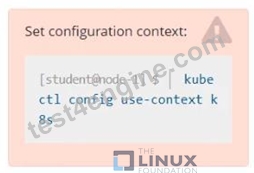
Task
Schedule a pod as follows:
* Name: nginx-kusc00401
* Image: nginx
* Node selector: disk=ssd
Answer:
Explanation:
See the solution below.
Explanation
Solution:
#yaml
apiVersion: v1
kind: Pod
metadata:
name: nginx-kusc00401
spec:
containers:
- name: nginx
image: nginx
imagePullPolicy: IfNotPresent
nodeSelector:
disk: spinning
#
kubectl create -f node-select.yaml
NEW QUESTION # 39
Get list of all pods in all namespaces and write it to file "/opt/pods-list.yaml"
Answer:
Explanation:
kubectl get po -all-namespaces > /opt/pods-list.yaml
NEW QUESTION # 40
Set the node namedek8s-node-1asunavailable and reschedule all thepods running on it.
Answer:
Explanation:
See the solution below.
Explanation
solution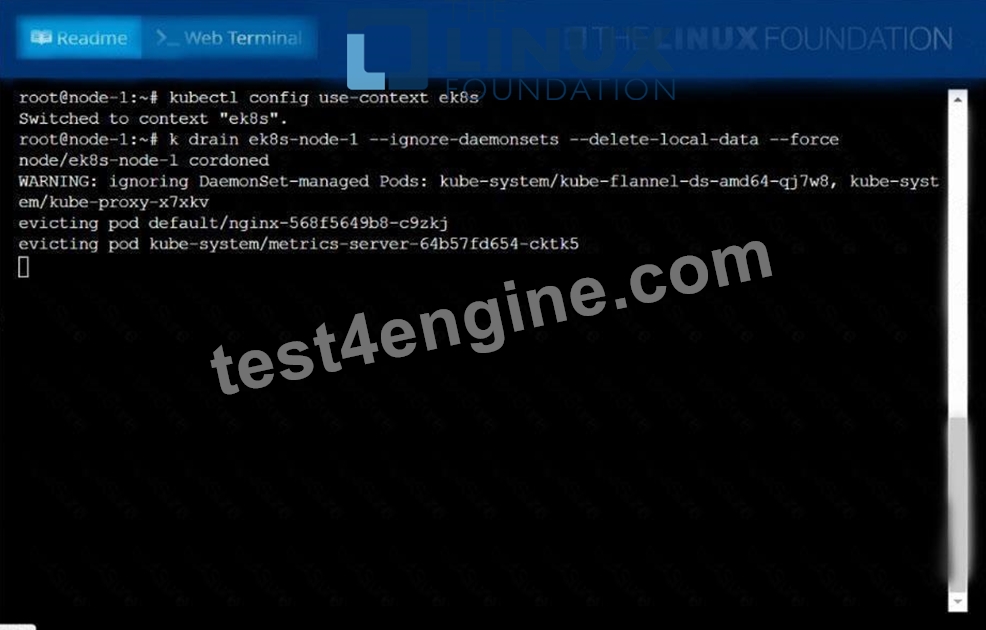
NEW QUESTION # 41
Delete the pod without any delay (force delete)
Answer:
Explanation:
Kubect1 delete po "POD-NAME" --grace-period=0 --force
NEW QUESTION # 42
Resume the rollout of the deployment
Answer:
Explanation:
kubectl rollout resume deploy webapp
NEW QUESTION # 43
Change the Image version to 1.15-alpine for the pod you just created and verify the image version is updated.
- A. Kubect1 set image pod/nginx nginx=nginx:1.15-alpine
kubect1 describe po nginx
// another way it will open vi editor and change the version
kubeclt edit po nginx
kubect1 describe po nginx - B. Kubect1 set image pod/nginx nginx=nginx:1.15-alpine
kubect1 describe po nginx
// another way it will open vi editor and change the version
kubect1 describe po nginx
Answer: A
NEW QUESTION # 44
Create a ETCD backup of kubernetes cluster
Note : You don't need to memorize command, refer -
https://kubernetes.io/docs/tasks/administer-cluster/configureupgrade-etcd/ during exam
- A. ETCDCTL_API=3 etcdctl --endpoints=[ENDPOINT] --cacert=[CA CERT]
--cert=[ETCD SERVER CERT] --key=[ETCD SERVER KEY] snapshot save
[BACKUP FILE NAME]
In exam, cluster setup is done with kubeadm , this means ETCD
used by the kubernetes cluster is coming from static pod.
kubectl get pod -n kube-system
kubectl describe pod etcd-master -n kube-system
You can locate the information on
endpoint: - advertise-client-urls=https://172.17.0.15:2379
ca certificate: - trusted-cafile=/etc/kubernetes/pki/etcd/ca.crt
server certificate : - certfile=/etc/kubernetes/pki/etcd/server.crt
key: - key-file=/etc/kubernetes/pki/etcd/server.key
To Create backup
export ETCDCTL_API=3
(or)
ETCDCTL_API=3 etcdctl ETCDCTL_API=3 etcdctl --
endpoints=https://172.17.0.15:2379 --
cacert=/etc/kubernetes/pki/etcd/ca.crt --
cert=/etc/kubernetes/pki/etcd/server.crt --
key=/etc/kubernetes/pki/etcd/server.key snapshot save etcdsnapshot.db
//Verify
ETCDCTL_API=3 etcdctl --write-out=table snapshot status
snapshot.db - B. ETCDCTL_API=3 etcdctl --endpoints=[ENDPOINT] --cacert=[CA CERT]
--cert=[ETCD SERVER CERT] --key=[ETCD SERVER KEY] snapshot save
[BACKUP FILE NAME]
In exam, cluster setup is done with kubeadm , this means ETCD
used by the kubernetes cluster is coming from static pod.
kubectl get pod -n kube-system
kubectl describe pod etcd-master -n kube-system
You can locate the information on
endpoint: - advertise-client-urls=https://172.16.0.18:2379
ca certificate: - trusted-cafile=/etc/kubernetes/pki/etcd/ca.crt
server certificate : - certfile=/etc/kubernetes/pki/etcd/server.crt
key: - key-file=/etc/kubernetes/pki/etcd/server.key
To Create backup
export ETCDCTL_API=3
(or)
ETCDCTL_API=3 etcdctl ETCDCTL_API=3 etcdctl --
endpoints=https://172.17.0.15:2379 --
key=/etc/kubernetes/pki/etcd/server.key snapshot save etcdsnapshot.db
//Verify
ETCDCTL_API=3 etcdctl --write-out=table snapshot status
snapshot.db
Answer: A
NEW QUESTION # 45
Create the deployment redis with image=redis and expose it with "NodePort" service redis-service
- A. kubectl create deploy redis --image=redis --dry-run -o yaml >
redis-deploy.yaml
Edit redis-deploy.yaml file
vim redis-deploy.yaml
apiVersion: apps/v1
kind: Deployment
metadata:
labels:
app: redis
name: redis
spec:
replicas: 1
selector:
matchLabels:
app: redis
template:
metadata:
labels:
app: redis
spec:
containers:
- image: redis
name: redis
//Creating Service
kubectl expose deploy redis --type=NodePort --port=6379 --
target-port=6379 --name redis-service
// Verify
kubectl get deploy,svc - B. kubectl create deploy redis --image=redis --dry-run -o yaml >
redis-deploy.yaml
Edit redis-deploy.yaml file
name: redis
spec:
replicas: 1
selector:
matchLabels:
app: redis
template:
metadata:
labels:
app: redis
spec:
containers:
- image: redis
name: redis
//Creating Service
kubectl expose deploy redis --type=NodePort --port=6379 --
target-port=6379 --name redis-service
// Verify
kubectl get deploy,svc
Answer: A
NEW QUESTION # 46
Create a pod that echo "hello world" and then exists. Have the pod deleted automatically when it's completed
Answer:
Explanation:
See the solution below.
Explanation
kubectl run busybox --image=busybox -it --rm --restart=Never --
/bin/sh -c 'echo hello world'
kubectl get po # You shouldn't see pod with the name "busybox"
NEW QUESTION # 47
Create a snapshot of the etcd instance running at https://127.0.0.1:2379, saving the snapshot to the file path
/srv/data/etcd-snapshot.db.
The following TLS certificates/key are supplied for connecting to the server with etcdctl:
CA certificate: /opt/KUCM00302/ca.crt
Client certificate: /opt/KUCM00302/etcd-client.crt
Client key: Topt/KUCM00302/etcd-client.key
Answer:
Explanation:
See the solution below.
Explanation
solution
F:\Work\Data Entry Work\Data Entry\20200827\CKA\18 C.JPG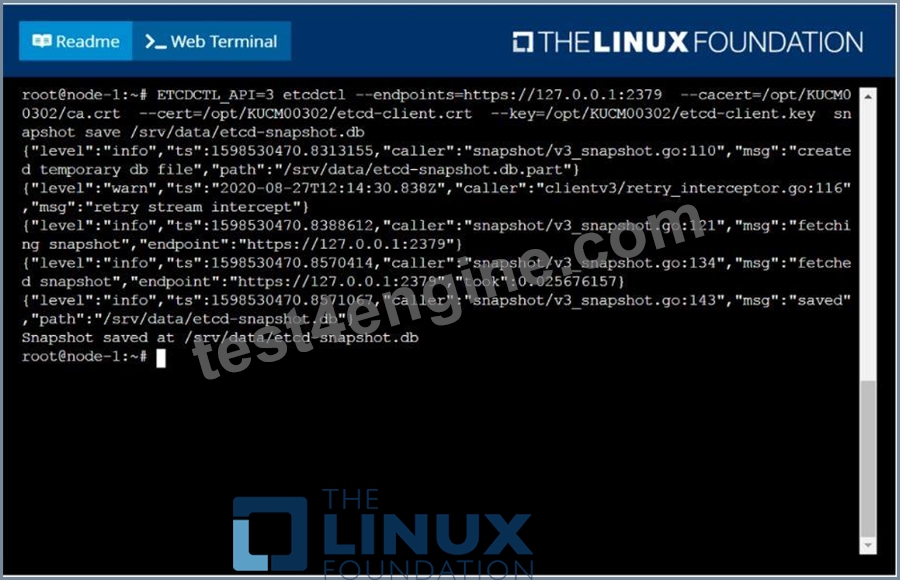
NEW QUESTION # 48
Undo the deployment to the previous version 1.17.1 and verify Image has the previous version
Answer:
Explanation:
kubectl rollout undo deploy webapp kubectl describe deploy webapp | grep Image
NEW QUESTION # 49
Configure the kubelet systemd- managed service, on the node labelled with name=wk8s-node-1, to launch a pod containing a single container of Image httpd named webtool automatically. Any spec files required should be placed in the /etc/kubernetes/manifests directory on the node.
You can ssh to the appropriate node using:
[student@node-1] $ ssh wk8s-node-1
You can assume elevated privileges on the node with the following command:
[student@wk8s-node-1] $ | sudo -i
Answer:
Explanation:
See the solution below.
Explanation
solution
F:\Work\Data Entry Work\Data Entry\20200827\CKA\21 C.JPG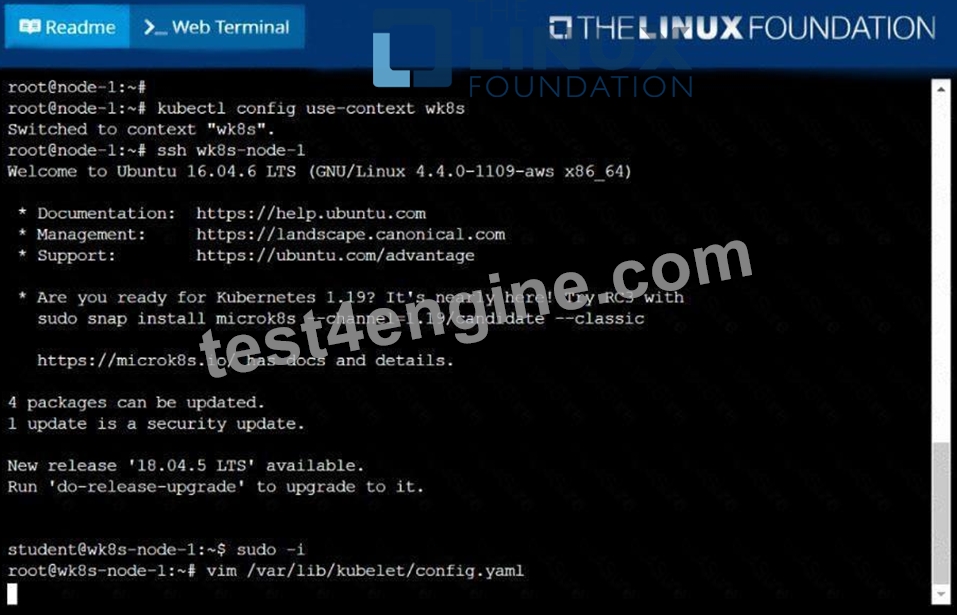
F:\Work\Data Entry Work\Data Entry\20200827\CKA\21 D.JPG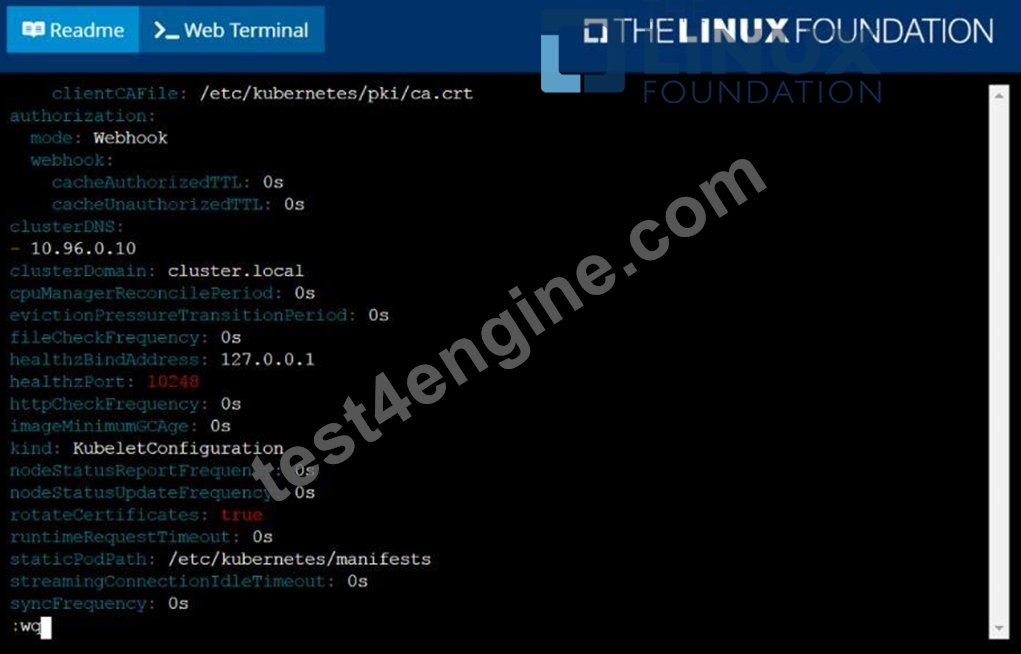
F:\Work\Data Entry Work\Data Entry\20200827\CKA\21 E.JPG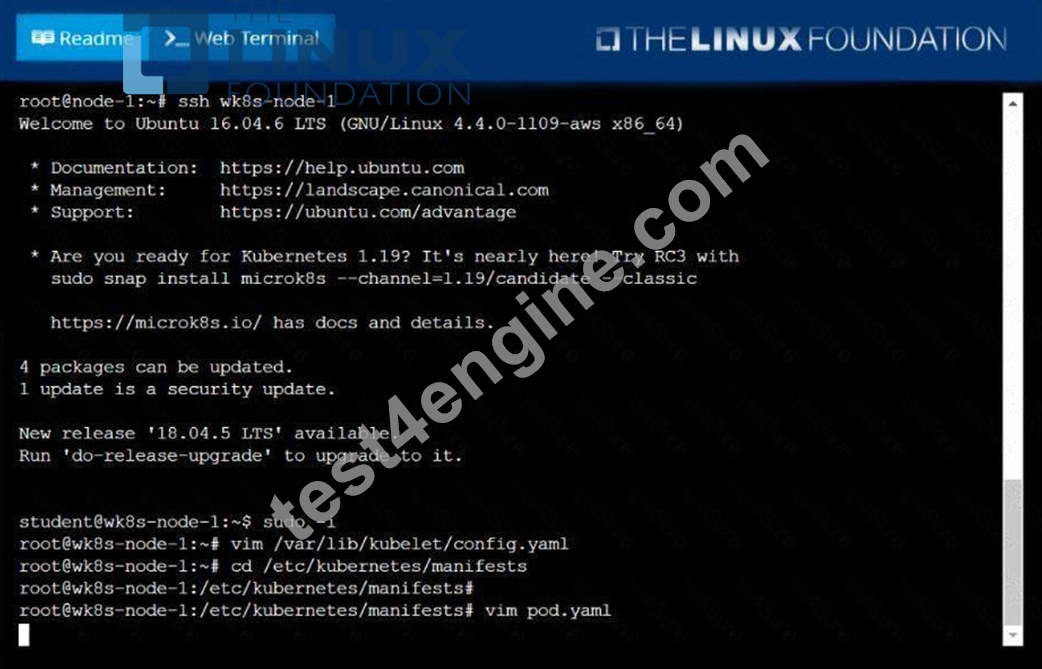
F:\Work\Data Entry Work\Data Entry\20200827\CKA\21 F.JPG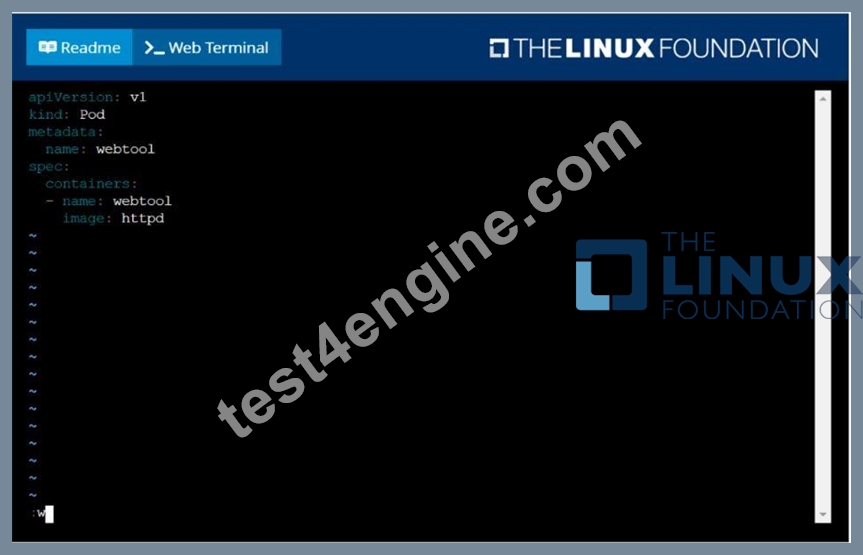
F:\Work\Data Entry Work\Data Entry\20200827\CKA\21 G.JPG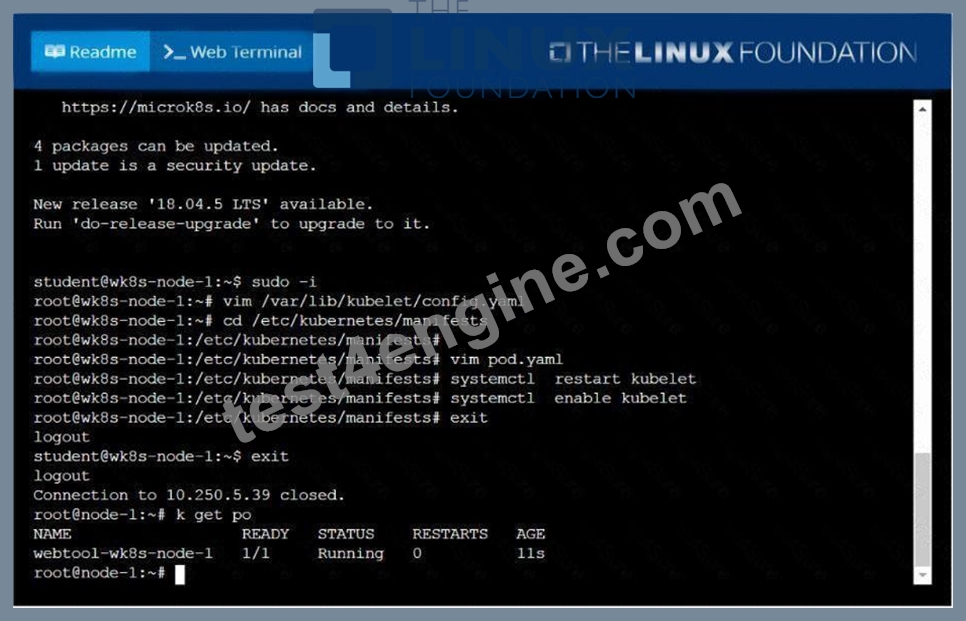
NEW QUESTION # 50
For this item, you will havetosshto the nodesik8s-master-0andik8s-node-0and complete all tasks on thesenodes. Ensure that you return tothe base node (hostname:node-1) when you havecompleted this item.
Context
As an administrator of a smalldevelopment team, you have beenasked to set up a Kubernetes clusterto test the viability of a newapplication.
Task
You must usekubeadmto performthis task. Anykubeadminvocationswill require the use of the
--ignore-preflight-errors=alloption.
* Configure thenodeik8s-master-Oas a masternode. .
* Join the nodeik8s-node-otothe cluster.
Answer:
Explanation:
See the solution below.
Explanation
solution
You must use thekubeadmconfiguration file located at when initializingyour cluster.
You may use any CNI pluginto complete this task, but ifyou don't have your favouriteCNI plugin's manifest URL athand, Calico is one popularoption:https://docs.projectcalico.org/v3.14/manifests/calico.yaml Docker is already installedon both nodes and hasbeen configured so that you caninstall the required tools.
NEW QUESTION # 51
Check the history of deployment
Answer:
Explanation:
kubectl rollout history deployment webapp
NEW QUESTION # 52
Ensure a single instance of pod nginx is running on each node of the Kubernetes cluster where nginx also represents the Image name which has to be used. Do not override any taints currently in place.
Use DaemonSet to complete this task and use ds-kusc00201 as DaemonSet name.
Answer:
Explanation:
See the solution below.
Explanation
solution
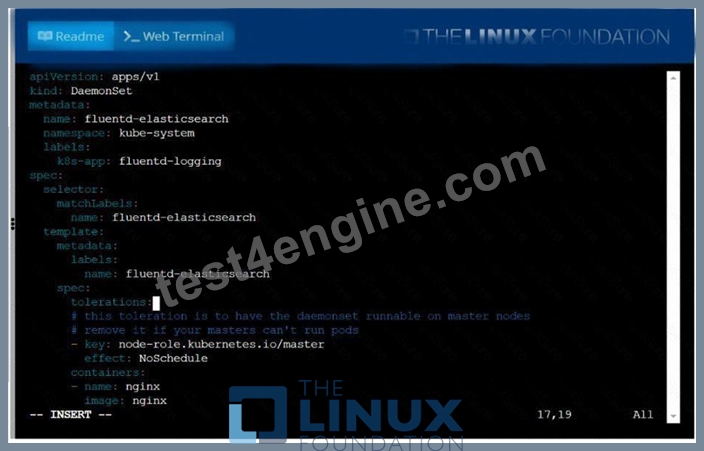

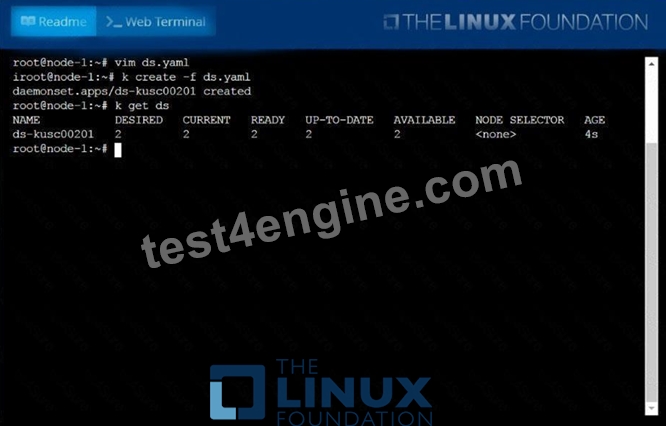
NEW QUESTION # 53
Create a namespace called 'development' and a pod with image nginx called nginx on this namespace.
Answer:
Explanation:
kubectl create namespace development kubectl run nginx --image=nginx --restart=Never -n development
NEW QUESTION # 54
Create a pod with image nginx called nginx and allow traffic on port 80
Answer:
Explanation:
kubectl run nginx --image=nginx --restart=Never --port=80
NEW QUESTION # 55
......
The CKA exam is a hands-on, performance-based exam that requires candidates to demonstrate their knowledge of Kubernetes administration through the use of practical tasks and challenges. CKA exam is designed to test an individual's ability to configure and manage Kubernetes clusters, troubleshoot common issues, and deploy applications using Kubernetes. CKA exam is administered online and can be taken from anywhere in the world.
CKA Exam Questions Get Updated [2024] with Correct Answers: https://actualtests.test4engine.com/CKA-real-exam-questions.html