


Download Online VALID MCPA-Level-1 Exam Dumps File Instantly[Oct 27, 2023]
MCPA-Level-1 Exam Dumps For Certification Exam Preparation
The MuleSoft MCPA-Level-1 exam covers a variety of topics related to the MuleSoft Anypoint Platform, including API-led connectivity, data integrations, application networks, and deployment strategies. Candidates are expected to have a deep understanding of these topics, as well as hands-on experience using the platform to build and deploy solutions.
NEW QUESTION # 22
An organization has implemented a Customer Address API to retrieve customer address information. This API has been deployed to multiple environments and has been configured to enforce client IDs everywhere.
A developer is writing a client application to allow a user to update their address. The developer has found the Customer Address API in Anypoint Exchange and wants to use it in their client application.
What step of gaining access to the API can be performed automatically by Anypoint Platform?
- A. Modify the client application to call the API using the client application's credentials
- B. Request access to the appropriate API Instances deployed to multiple environments using the client application's credentials
- C. Approve the client application request for the chosen SLA tier
- D. Create a new application in Anypoint Exchange for requesting access to the API
Answer: B
NEW QUESTION # 23
What do the API invocation metrics provided by Anypoint Platform provide?
- A. Proactive identification of likely future policy violations that exceed a given threat threshold
- B. Data on past API invocations to help identify anomalies and usage patterns across various APIs
- C. ROI metrics from APIs that can be directly shared with business users
- D. Measurements of the effectiveness of the application network based on the level of reuse
Answer: D
Explanation:
Explanation/Reference: https://usermanual.wiki/Document/APAAppNetstudentManual02may2018.991784750.pdf
NEW QUESTION # 24
A System API is designed to retrieve data from a backend system that has scalability challenges.
What API policy can best safeguard the backend system?
- A. IP whitelist
- B. SLA-based rate limiting
- C. OAuth 2 token enforcement
- D. Client ID enforcement
Answer: A
Explanation:
Explanation/Reference: https://dzone.com/articles/how-to-secure-apis
NEW QUESTION # 25
When designing an upstream API and its implementation, the development team has been advised to NOT set timeouts when invoking a downstream API, because that downstream API has no SLA that can be relied upon.
This is the only downstream API dependency of that upstream API.
- A. A default timeout of 500 ms will automatically be applied by the Mule runtime in which the upstream API implementation executes
- B. A toad-dependent timeout of less than 1000 ms will be applied by the Mule runtime in which the downstream API implementation executes
- C. The invocation of the downstream API will run to completion without timing out
- D. An SLA for the upstream API CANNOT be provided
- E. Assume the downstream API runs uninterrupted without crashing. What is the impact of this advice?
Answer: A
NEW QUESTION # 26
The responses to some HTTP requests can be cached depending on the HTTP verb used in the request. According to the HTTP specification, for what HTTP verbs is this safe to do?
- A. GET, HEAD, POST
- B. GET, PUT, OPTIONS
- C. PUT, POST, DELETE
- D. GET, OPTIONS, HEAD
Answer: D
Explanation:
Correct answer: GET, OPTIONS, HEAD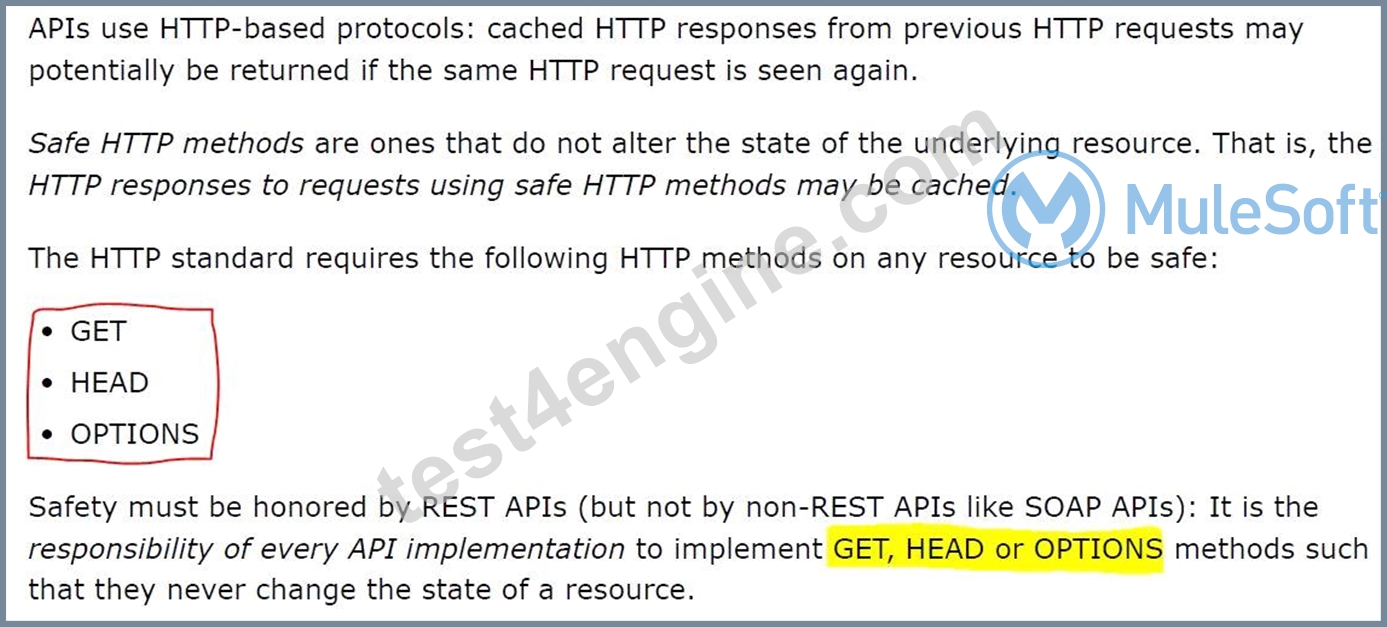
http://restcookbook.com/HTTP%20Methods/idempotency/
NEW QUESTION # 27
A retail company is using an Order API to accept new orders. The Order API uses a JMS queue to submit orders to a backend order management service. The normal load for orders is being handled using two (2) CloudHub workers, each configured with 0.2 vCore. The CPU load of each CloudHub worker normally runs well below 70%. However, several times during the year the Order API gets four times (4x) the average number of orders. This causes the CloudHub worker CPU load to exceed 90% and the order submission time to exceed 30 seconds. The cause, however, is NOT the backend order management service, which still responds fast enough to meet the response SLA for the Order API. What is the MOST resource-efficient way to configure the Mule application's CloudHub deployment to help the company cope with this performance challenge?
- A. Use a vertical CloudHub autoscaling policy that triggers on CPU utilization greater than 70%
- B. Use a horizontal CloudHub autoscaling policy that triggers on CPU utilization greater than 70%
- C. Permanently increase the number of CloudHub workers by four times (4x) to eight (8) CloudHub workers
- D. Permanently increase the size of each of the two (2) CloudHub workers by at least four times (4x) to one (1) vCore
Answer: B
Explanation:
Correct answer: Use a horizontal CloudHub autoscaling policy that triggers on CPU utilization greater than 70%
*****************************************
The scenario in the question is very clearly stating that the usual traffic in the year is pretty well handled by the existing worker configuration with CPU running well below 70%. The problem occurs only "sometimes" occasionally when there is spike in the number of orders coming in.
So, based on above, We neither need to permanently increase the size of each worker nor need to permanently increase the number of workers. This is unnecessary as other than those "occasional" times the resources are idle and wasted.
We have two options left now. Either to use horizontal Cloudhub autoscaling policy to automatically increase the number of workers or to use vertical Cloudhub autoscaling policy to automatically increase the vCore size of each worker.
Here, we need to take two things into consideration:
1. CPU
2. Order Submission Rate to JMS Queue
>> From CPU perspective, both the options (horizontal and vertical scaling) solves the issue. Both helps to bring down the usage below 90%.
>> However, If we go with Vertical Scaling, then from Order Submission Rate perspective, as the application is still being load balanced with two workers only, there may not be much improvement in the incoming request processing rate and order submission rate to JMS queue. The throughput would be same as before. Only CPU utilization comes down.
>> But, if we go with Horizontal Scaling, it will spawn new workers and adds extra hand to increase the throughput as more workers are being load balanced now. This way we can address both CPU and Order Submission rate.
Hence, Horizontal CloudHub Autoscaling policy is the right and best answer.
NEW QUESTION # 28
What best explains the use of auto-discovery in API implementations?
- A. It enables Anypoint Studio to discover API definitions configured in Anypoint Platform
- B. It enables Anypoint Analytics to gain insight into the usage of APIs
- C. It enables Anypoint Exchange to discover assets and makes them available for reuse
- D. It makes API Manager aware of API implementations and hence enables it to enforce policies
Answer: A
NEW QUESTION # 29
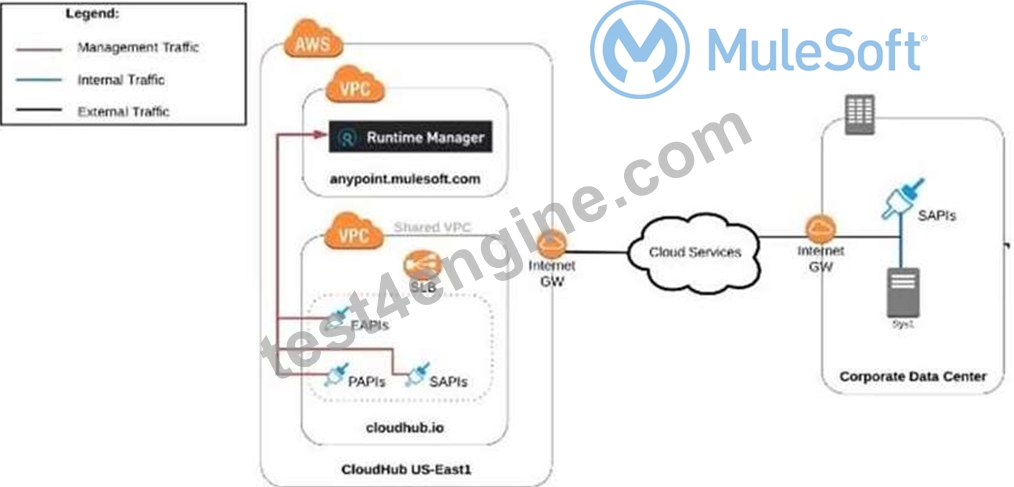
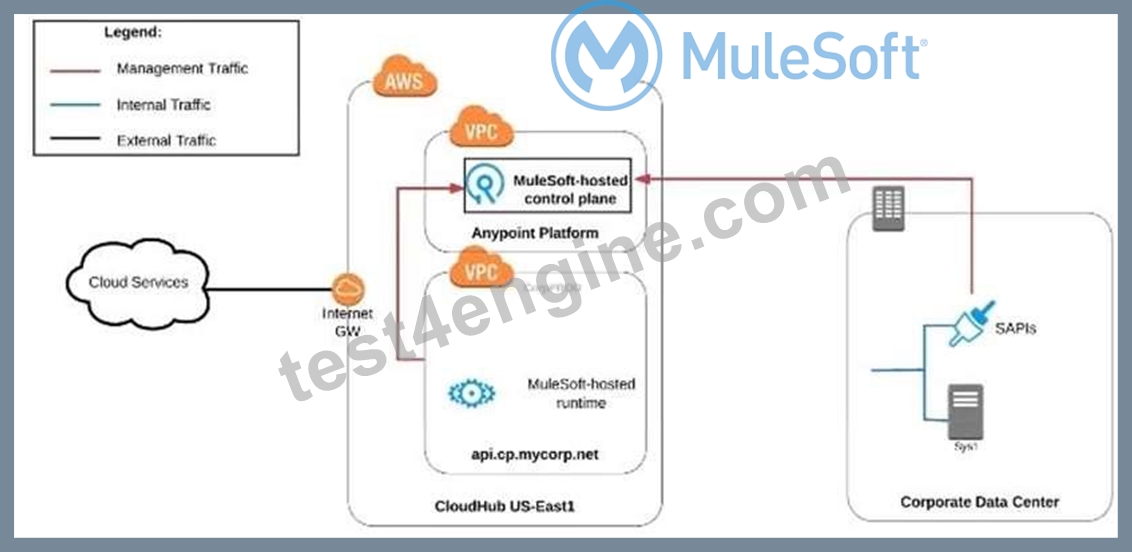
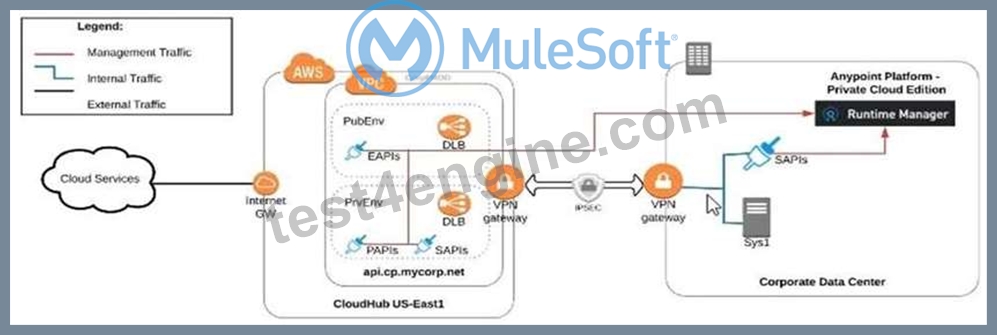
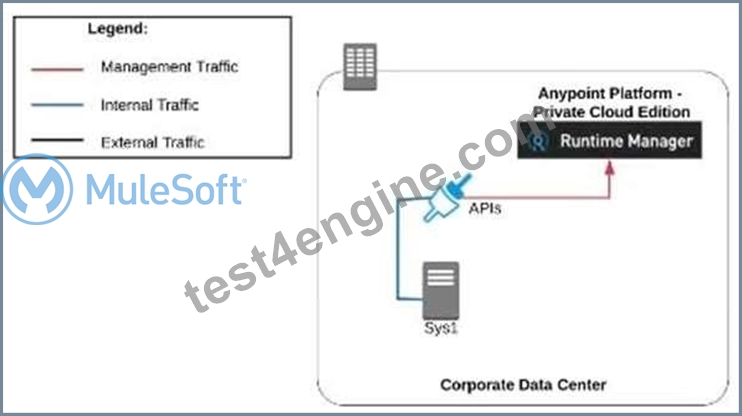
An organization uses various cloud-based SaaS systems and multiple on-premises systems. The on-premises systems are an important part of the organization's application network and can only be accessed from within the organization's intranet.
What is the best way to configure and use Anypoint Platform to support integrations with both the cloud-based SaaS systems and on-premises systems?
- A. Use CloudHub-deployed Mule runtimes in the shared worker cloud managed by the MuleSoft-hosted Anypoint Platform con
- B. Use a combination of CloudHub-deployed and manually provisioned on-premises Mule runtimes managed by the MuleSoft Platform control plane.
- C. Use CloudHub-deployed Mule runtimes in an Anypoint VPC managed by Anypoint Platform Private Cloud Edition control pl
- D. Use an on-premises installation of Mule runtimes that are completely isolated with NO external network access, managed by the Anypoint Platform Private Cloud Edition control plane.
Answer: A
Explanation:
Explanation/Reference:
NEW QUESTION # 30
What API policy would be LEAST LIKELY used when designing an Experience API that is intended to work with a consumer mobile phone or tablet application?
- A. IP whitelist
- B. OAuth 2.0 access token enforcement
- C. Client ID enforcement
- D. JSON threat protection
Answer: D
NEW QUESTION # 31
True or False. We should always make sure that the APIs being designed and developed are self-servable even if it needs more man-day effort and resources.
- A. FALSE
- B. TRUE
Answer: B
Explanation:
Correct answer: TRUE
*****************************************
>> As per MuleSoft proposed IT Operating Model, designing APIs and making sure that they are discoverable and self-servable is VERY VERY IMPORTANT and decides the success of an API and its application network.
NEW QUESTION # 32
An organization has implemented a Customer Address API to retrieve customer address information. This API has been deployed to multiple environments and has been configured to enforce client IDs everywhere.
A developer is writing a client application to allow a user to update their address. The developer has found the Customer Address API in Anypoint Exchange and wants to use it in their client application.
What step of gaining access to the API can be performed automatically by Anypoint Platform?
- A. Request access to the appropriate API Instances deployed to multiple environments using the client application's credentials
- B. Modify the client application to call the API using the client application's credentials
- C. Approve the client application request for the chosen SLA tier
- D. Create a new application in Anypoint Exchange for requesting access to the API
Answer: C
Explanation:
Correct answer: Approve the client application request for the chosen SLA tier
*****************************************
>> Only approving the client application request for the chosen SLA tier can be automated
>> Rest of the provided options are not valid
NEW QUESTION # 33
An organization has several APIs that accept JSON data over HTTP POST. The APIs are all publicly available and are associated with several mobile applications and web applications.
The organization does NOT want to use any authentication or compliance policies for these APIs, but at the same time, is worried that some bad actor could send payloads that could somehow compromise the applications or servers running the API implementations.
What out-of-the-box Anypoint Platform policy can address exposure to this threat?
- A. Apply an IP blacklist policy to all APIs; the blacklist will Include all bad actors
- B. Apply a JSON threat protection policy to all APIs to detect potential threat vectors
- C. Shut out bad actors by using HTTPS mutual authentication for all API invocations
- D. Apply a Header injection and removal policy that detects the malicious data before it is used
Answer: B
Explanation:
Correct answer: Apply a JSON threat protection policy to all APIs to detect potential threat vectors
*****************************************
>> Usually, if the APIs are designed and developed for specific consumers (known consumers/customers) then we would IP Whitelist the same to ensure that traffic only comes from them.
>> However, as this scenario states that the APIs are publicly available and being used by so many mobile and web applications, it is NOT possible to identify and blacklist all possible bad actors.
>> So, JSON threat protection policy is the best chance to prevent any bad JSON payloads from such bad actors.
NEW QUESTION # 34
When using CloudHub with the Shared Load Balancer, what is managed EXCLUSIVELY by the API implementation (the Mule application) and NOT by Anypoint Platform?
- A. The SSL certificates used by the API implementation to expose HTTPS endpoints
- B. The number of DNS entries allocated to the API implementation
- C. The assignment of each HTTP request to a particular CloudHub worker
- D. The logging configuration that enables log entries to be visible in Runtime Manager
Answer: A
Explanation:
Correct answer: The SSL certificates used by the API implementation to expose HTTPS endpoints
*****************************************
>> The assignment of each HTTP request to a particular CloudHub worker is taken care by Anypoint Platform itself. We need not manage it explicitly in the API implementation and in fact we CANNOT manage it in the API implementation.
>> The logging configuration that enables log entries to be visible in Runtime Manager is ALWAYS managed in the API implementation and NOT just for SLB. So this is not something we do EXCLUSIVELY when using SLB.
>> We DO NOT manage the number of DNS entries allocated to the API implementation inside the code. Anypoint Platform takes care of this.
It is the SSL certificates used by the API implementation to expose HTTPS endpoints that is to be managed EXCLUSIVELY by the API implementation. Anypoint Platform does NOT do this when using SLBs.
NEW QUESTION # 35
Which of the following best fits the definition of API-led connectivity?
- A. API-led connectivity is a 3-layered architecture covering Experience, Process and System layers
- B. API-led connectivity is not just an architecture or technology but also a way to organize people and processes for efficient IT delivery in the organization
- C. API-led connectivity is a technology which enabled us to implement Experience, Process and System layer based APIs
Answer: B
Explanation:
Correct answer: API-led connectivity is not just an architecture or technology but also a way to organize people and processes for efficient IT delivery in the organization.
*****************************************
Reference: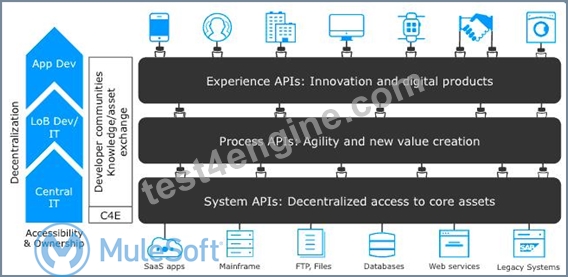
NEW QUESTION # 36
An API implementation is deployed to CloudHub.
What conditions can be alerted on using the default Anypoint Platform functionality, where the alert conditions depend on the end-to-end request processing of the API implementation?
- A. When the API receives a very high number of API invocations
- B. When a particular API client invokes the API too often within a given time period
- C. When the API is invoked by an unrecognized API client
- D. When the response time of API invocations exceeds a threshold
Answer: B
NEW QUESTION # 37
Refer to the exhibit.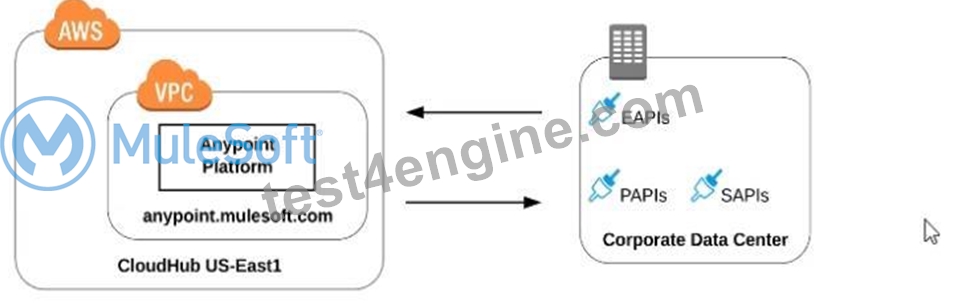
what is true when using customer-hosted Mule runtimes with the MuleSoft-hosted Anypoint Platform control plane (hybrid deployment)?
- A. The MuleSoft-hosted Shared Load Balancer can be used to load balance API invocations to the Mule runtimes
- B. API implementations can run successfully in customer-hosted Mule runtimes, even when they are unable to communicate with the control plane
- C. Anypoint Runtime Manager initiates a network connection to a Mule runtime in order to deploy Mule applications
- D. Anypoint Runtime Manager automatically ensures HA in the control plane by creating a new Mule runtime instance in case of a node failure
Answer: D
NEW QUESTION # 38
An organization is deploying their new implementation of the OrderStatus System API to multiple workers in CloudHub. This API fronts the organization's on-premises Order Management System, which is accessed by the API implementation over an IPsec tunnel.
What type of error typically does NOT result in a service outage of the OrderStatus System API?
- A. The Order Management System is Inaccessible due to a network outage in the organization's on-premises data center
- B. The AWS region goes offline with a major network failure to the relevant AWS data centers
- C. API Manager has an extended outage during the initial deployment of the API implementation
- D. A CloudHub worker fails with an out-of-memory exception
Answer: A
NEW QUESTION # 39
What is a key requirement when using an external Identity Provider for Client Management in Anypoint Platform?
- A. APIs managed by Anypoint Platform must be protected by SAML 2.0 policies
- B. The application network must include System APIs that interact with the Identity Provider
- C. Single sign-on is required to sign in to Anypoint Platform
- D. To invoke OAuth 2.0-protected APIs managed by Anypoint Platform, API clients must submit access tokens issued by that same Identity Provider
Answer: D
Explanation:
https://www.folkstalk.com/2019/11/mulesoft-integration-and-platform.html Explanation:
Correct answer: To invoke OAuth 2.0-protected APIs managed by Anypoint Platform, API clients must submit access tokens issued by that same Identity Provider
*****************************************
>> It is NOT necessary that single sign-on is required to sign in to Anypoint Platform because we are using an external Identity Provider for Client Management
>> It is NOT necessary that all APIs managed by Anypoint Platform must be protected by SAML 2.0 policies because we are using an external Identity Provider for Client Management
>> Not TRUE that the application network must include System APIs that interact with the Identity Provider because we are using an external Identity Provider for Client Management Only TRUE statement in the given options is - "To invoke OAuth 2.0-protected APIs managed by Anypoint Platform, API clients must submit access tokens issued by that same Identity Provider" References:
https://docs.mulesoft.com/api-manager/2.x/external-oauth-2.0-token-validation-policy
https://blogs.mulesoft.com/dev/api-dev/api-security-ways-to-authenticate-and-authorize/
NEW QUESTION # 40
Select the correct Owner-Layer combinations from below options
- A. 1. App Developers owns and focuses on Experience Layer APIs
2. Central IT owns and focuses on Process Layer APIs
3. LOB IT owns and focuses on System Layer APIs - B. 1. Central IT owns and focuses on Experience Layer APIs
2. LOB IT owns and focuses on Process Layer APIs
3. App Developers owns and focuses on System Layer APIs - C. 1. App Developers owns and focuses on Experience Layer APIs
2. LOB IT owns and focuses on Process Layer APIs
3. Central IT owns and focuses on System Layer APIs
Answer: C
Explanation:
Correct answer:
1. App Developers owns and focuses on Experience Layer APIs
2. LOB IT owns and focuses on Process Layer APIs
3. Central IT owns and focuses on System Layer APIs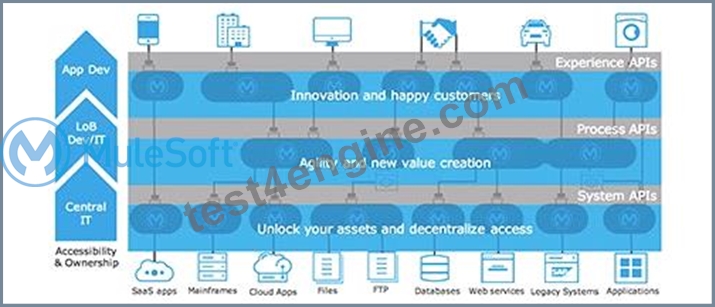
References:
https://blogs.mulesoft.com/biz/api/experience-api-ownership/
https://blogs.mulesoft.com/biz/api/process-api-ownership/
https://blogs.mulesoft.com/biz/api/system-api-ownership/
NEW QUESTION # 41
......
The MCPA-Level-1 certification exam is a challenging exam that requires thorough preparation and study. Candidates must have a strong understanding of MuleSoft's Anypoint Platform and be familiar with its architecture, components, and capabilities. They must also have experience designing and developing MuleSoft applications and be familiar with industry best practices for integration and API design.
Latest Verified & Correct MCPA-Level-1 Questions: https://actualtests.test4engine.com/MCPA-Level-1-real-exam-questions.html