


Best Quality Cloud-Digital-Leader Exam Questions Google Test To Gain Brilliante Result!
Preparations of Cloud-Digital-Leader Exam 2022 Google Cloud Certified Unlimited 224 Questions
Who needs to take Google Cloud Digital Leader Exam?
There are a variety of opportunities for students who are willing to take up the challenge that the digital economy presents. To make sure that students remain sharp and in tune with the latest technological developments, Google has recently announced its certification program for cloud solutions. The Cloud Digital Leader (CDL) certification is designed to test and certify the skills of IT professionals in cloud computing solutions. Google Cloud Digital Leader Dumps are written to the highest standards of technical accuracy, provided by our certified subject-matter experts and published authors for development.
In addition to the CDL certification, there are other certifications like Google Certified Professional Developer, Google Certified System Administrator, Google Certified Big Data Engineer, and Google Certified Solutions Architect. Those who have successfully passed the exam will have their names listed on GCP's Certification Register and earn a digital badge on their public profiles on GCP Marketplace. Lift the covers on features like Cloud Spanner and Datastore.
NEW QUESTION 129
Which Google Cloud product can report on and maintain compliance on your entire Google Cloud organization to cover multiple projects?
- A. Identity and Access Management
- B. Google Cloud Armor
- C. Cloud Logging
- D. Security Command Center
Answer: A
NEW QUESTION 130
Cloud Data Loss Prevention (DLP) is a fully managed service designed to help discover, classify, and protect the most sensitive dat a. DLP provides three key features (Select Three Answers)
- A. De-classification
- B. Inspection
- C. Reinspection
- D. Classification
- E. De-identification
Answer: B,D,E
Explanation:
Classification. De-classification and Inspection
Classification is the process to inspect the data and know what data we have, how sensitive it is, and the likelihood. Inspection and classification happen here.
De-identification is the process of removing, masking, replacing information from data.
Reference link- https://cloud.google.com/dlp/docs
NEW QUESTION 131
How should a multinational organization that is migrating to Google Cloud consider security and privacy regulations to ensure that it is in compliance with global standards?
- A. Comply with regional data security regulations, because they're more complex than privacy standards
- B. Comply with data security and privacy regulations in each geographical region
- C. Comply with international standards for data security and privacy, because they supersede all regional regulations
- D. Comply with regional standards for data security and privacy, because they supersede all international regulations
Answer: C
NEW QUESTION 132
The customer has applications that do data processing on-premise. They have been built using Ha-doop and Spark. What product should I use on Google Cloud?
- A. Dataplex
- B. Dataproc
- C. Dataprep
- D. Dataflow
Answer: B
Explanation:
Because Dataproc is used to run Hadoop/Spark workloads
NEW QUESTION 133
Your organization needs to analyze data in order to gather insights into its daily operations. You only want to pay for the data you store and the queries you perform. Which Google Cloud product should your organization choose for its data analytics warehouse?
- A. Cloud SQL
- B. BigQuery
- C. Dataproc
- D. Cloud Spanner
Answer: B
Explanation:
BigQuery is an enterprise data warehouse for large amounts of relational structured data Serverless, highly scalable, and cost-effective multicloud data warehouse designed for business agility.
NEW QUESTION 134
Your organization wants to run a container-based application on Google Cloud. This application is expected to increase in complexity. You have a security need for fine-grained control of traffic between the containers. You also have an operational need to exercise fine-grained control over the application's scaling policies.
What Google Cloud product or feature should your organization use?
- A. Compute Engine virtual machines
- B. Google Kubernetes Engine cluster
- C. Cloud Run
- D. App Engine
Answer: C
NEW QUESTION 135
Your client has an on-premises data center. Due to technical limitations, they are unable to scale globally. They have decided to adopt the public cloud. However, they don't want to locked into any one vendor and, therefore, would like to work with multiple cloud providers. They have used open source container technologies and would like to continue using them.
- A. Kubernetes that runs containers as their core workloads
- B. Anthos that runs containers as their core workloads
- C. Cloud Run which supports containers and can scale in a serverless fashion
- D. AppEngine Flexible Environment which supports containers
Answer: B
Explanation:
Anthos unifies the management of infrastructure and applications across on-premises, edge, and in multiple public clouds with a Google Cloud-backed control plane for consistent operation at scale.
NEW QUESTION 136
Your organization uses Active Directory to authenticate users. Users' Google account access must be removed when their Active Directory account is terminated.
How should your organization meet this requirement?
- A. Configure single sign-on in the Google domain
- B. Configure two-factor authentication in the Google domain
- C. Configure BeyondCorp and Identity-Aware Proxy in the Google domain
- D. Remove the Google account from all IAM policies
Answer: A
NEW QUESTION 137
You are a program manager within a Software as a Service (SaaS) company that offers rendering software for animation studios. Your team needs the ability to allow scenes to be scheduled at will and to be interrupted at any time to restart later. Any individual scene rendering takes less than 12 hours to complete, and there is no service-level agreement (SLA) for the completion time for all scenes. Results will be stored in a global Cloud Storage bucket. The compute resources are not bound to any single geographical location. This software needs to run on Google Cloud in a cost-optimized way.
What should you do?
- A. Create a reservation for the minimum number of Compute Engine instances you will use
- B. Develop the application so it can run in an unmanaged instance group
- C. Deploy the application on Compute Engine using preemptible instances
- D. Start more instances with fewer virtual centralized processing units (vCPUs) instead of fewer instances with more vCPUs
Answer: C
NEW QUESTION 138
Your manager wants to restrict communication of all virtual machines with internet access; with resources in another network; or with a resource outside Compute Engine. It is expected that different teams will create new folders and projects in the near future.
How would you restrict all virtual machines from having an external IP address?
- A. Define an organization policy on all existing folders to define a constraint to restrict virtual machine instances from having an external IP address
- B. Define an organization policy on all existing projects to restrict virtual machine instances from having an external IP address
- C. Define an organization policy at the root organization node to restrict virtual machine instances from having an external IP address
- D. Communicate with the different teams and agree that each time a virtual machine is created, it must be configured without an external IP address
Answer: C
NEW QUESTION 139
A customer deploys an application to App Engine and needs to check for Open Web Appli-cation Security Project (OWASP) vulnerabilities. Which service should be used to accom-plish this?
- A. Cloud Armor
- B. Cloud Security Scanner
- C. Forseti Security
- D. Binary Authorization
Answer: B
Explanation:
Web Security Scanner identifies security vulnerabilities in your App Engine, Google Kubernetes Engine (GKE), and Compute Engine web applications. It crawls your application, following all links within the scope of your starting URLs, and attempts to exercise as many user inputs and event handlers as possible.
Currently, Web Security Scanner only supports public URLs and IPs that aren't behind a firewall. Web Security Scanner currently supports the App Engine standard environment and App Engine flexible environments, Compute Engine instances, and GKE resources.
Reference link- https://cloud.google.com/security-command-center/docs/concepts-web-security-scanner-overview
NEW QUESTION 140
An organization wants to evaluate the performance of their entire cloud infrastructure, including metrics like server uptime and response rate reports. Which Google Cloud tool should the organi-zation use?
- A. Cloud Trace
- B. Cloud Profiler
- C. Cloud Debugger
- D. Cloud Monitoring
Answer: D
Explanation:
Because Cloud Monitoring enables users to monitor the performance of their entire cloud infrastructure.
NEW QUESTION 141
You are a program manager within a Software as a Service (SaaS) company that offers rendering software for animation studios. Your team needs the ability to allow scenes to be scheduled at will and to be interrupted at any time to restart later. Any individual scene rendering takes less than 12 hours to complete, and there is no service-level agreement (SLA) for the completion time for all scenes. Results will be stored in a global Cloud Storage bucket. The compute resources are not bound to any single geographical location. This software needs to run on Google Cloud in a cost-optimized way.
What should you do?
- A. Create a reservation for the minimum number of Compute Engine instances you will use
- B. Develop the application so it can run in an unmanaged instance group
- C. Deploy the application on Compute Engine using preemptible instances
- D. Start more instances with fewer virtual centralized processing units (vCPUs) instead of fewer instances with more vCPUs
Answer: C
Explanation: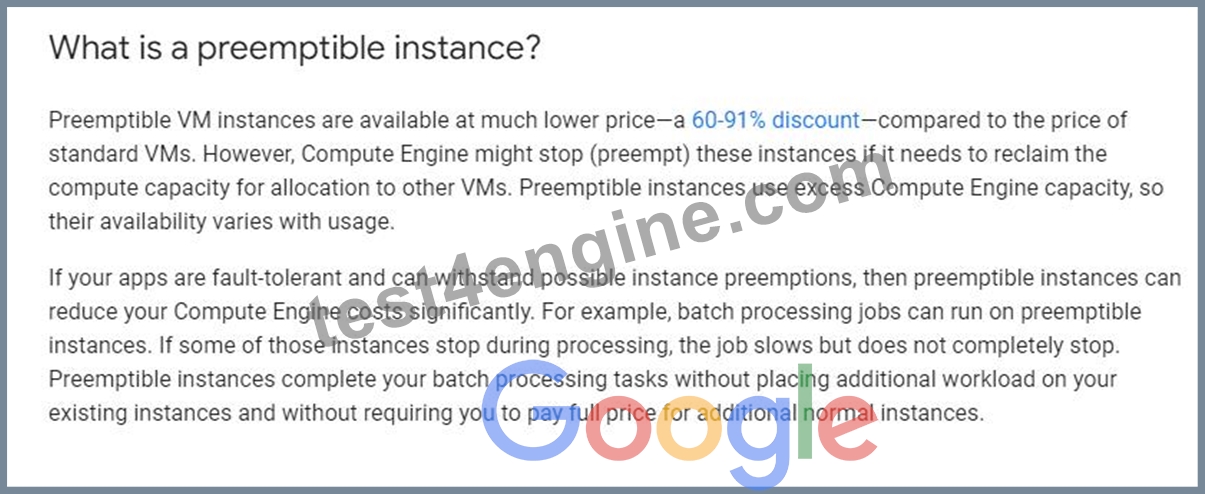
https://cloud.google.com/compute/docs/instances/preemptible
NEW QUESTION 142
Your organization wants an economical solution to store data such as files, graphical images, and videos and to access and share them securely.
Which Google Cloud product or service should your organization use?
- A. Cloud SQL
- B. Cloud Storage
- C. BigQuery
- D. Cloud Spanner
Answer: B
NEW QUESTION 143
You have contracted a partner to conduct some medical trials. This is a limited, 2-month contract. At the end of each day, you are expecting about 10 Gbs of dat a. The data is highly sensitive. What networking option would you employ?
- A. Setup Cloud VPN and create an IPsec VPN tunnel with your partner.
- B. Create a public IP for a VM and share that with your partners so that they can access it over the internet and share the data.
- C. As the name indicates, set up Partner Interconnect with your partner company.
- D. Setup Dedicated Interconnect with your partner.
Answer: A
Explanation:
"Cloud VPN securely extends your peer network to Google's network through an IPsec VPN tunnel. Traffic is encrypted and travels between the two networks over the public internet. Cloud VPN is useful for low-volume data connections. For additional connection options, see the Hybrid Connectivity product page."
NEW QUESTION 144
Each of the three cloud service models - infrastructure as a service (IaaS), platform as a service (PaaS), and software as a service (SaaS) - offers benefits between flexibility and levels of management by the cloud provider and the customer.
Why would SaaS be the right choice of service model?
- A. You want to minimize the level of management by the customer
- B. You want to be able to shift your emphasis between flexibility and management by the cloud provider as business needs change
- C. You want to maximize flexibility for the customer.
- D. You want a balance between flexibility for the customer and the level of management by the cloud provider
Answer: A
Explanation:
Benefits of SaaS
The main benefit of SaaS is that it offloads all infrastructure and application management to the SaaS vendor.
Reference:
NEW QUESTION 145
You're negotiating SLAs with a customer. You have communicated that there will be a 99.99% (four 9s) availability for the service you are providing. Every aspect of the service is under your con-trol. They want to modify the reliability to 99.999% (five 9s). What do you tell them? (Choose two answer)
- A. Yes, that could be possible. If yes, there will be a significantly higher charge be-cause the effort is significantly higher too.
- B. Yes, that is possible. There is hardly any difference to provide another 0.009% availability.
- C. Yes, that is possible, but there will be an additional charge of 9% for the service because that is the additional effort required.
- D. Ask them for the reasonable downtime they are willing to absorb. If it is more than 60 minutes in an entire year, explain how the current SLA meets that requirement.
Answer: A,D
Explanation:
In many cases, customers might not know the implications of the 9s with respect to scheduled maintenance, upgrades, etc. It's possible that they are holding unnecessary expectations that significantly exceed their requirements.
-> Even though 0.0009 % increase it looks like a small increment, an addition of a single 9 reduces the possible downtime by 10 times. So the effort is often much greater.
Reference link- https://en.wikipedia.org/wiki/High_availability
NEW QUESTION 146
You are currently managing workloads running on Windows Server for which your company owns the licenses. Your workloads are only needed during working hours, which allows you to shut down the instances during the weekend. Your Windows Server licenses are up for renewal in a month, and you want to optimize your license cost.
What should you do?
- A. Renew your licenses for an additional period of 3 years. Renew your licenses for an additional period of 3 years. Negotiate a cost reduction with your current hosting provider wherein infrastructure cost is reduced when workloads are not in use
- B. Migrate the workloads to Compute Engine with a pay-as-you-go (PAYG) model
- C. Renew your licenses for an additional period of 2 years. Negotiate a cost reduction by committing to an automatic renewal of the licenses at the end of the 2 year period
- D. Migrate the workloads to Compute Engine with a bring-your-own-license (BYOL) model
Answer: D
NEW QUESTION 147
In terms of Dockers and Kubernetes, which of the following statements are correct?
- A. All of the above.
- B. Kubernetes can be used with or without Docker.
- C. Kubernetes uses Docker to deploy, manage, and scale containerized applications.
- D. Difference between Docker and Kubernetes relates to the role each play in con-tainerizing and running your applications
Answer: A
Explanation:
Kubernetes vs. Docker
Often misunderstood as a choice between one or the other, Kubernetes and Docker are different yet complementary technologies for running containerized applications.
Docker lets you put everything you need to run your application into a box that can be stored and opened when and where it is required. Once you start boxing up your applications, you need a way to manage them; and that's what Kubernetes does.
Kubernetes is a Greek word meaning 'captain' in English. Like the captain is responsible for the safe journey of the ship in the seas, Kubernetes is responsible for carrying and delivering those boxes safely to locations where they can be used.
- Kubernetes can be used with or without Docker.
- Docker is not an alternative to Kubernetes, so it's less of a "Kubernetes vs. Docker" question. It's about using Kubernetes with Docker to containerize your applications and run them at scale.
- The difference between Docker and Kubernetes relates to the role each play in containerizing and running your applications.
- Docker is an open industry standard for packaging and distributing applications in containers.
- Kubernetes uses Docker to deploy, manage, and scale containerized applications.
NEW QUESTION 148
Your ed-tech start-up was originally launched in a small geography. Any user sign-ups, course progress, tests taken, etc. are captured on a self-managed MySQL database. Every user generates many such transactions. Now you're taking the application globally and preparing for a much larger influx of users from all over the world. The existing MySQL server is unlikely to be able to scale. Which convenient option can be considered?
- A. Migrate to Cloud SQL
- B. Migrate to Bigtable
- C. Migrate to BigQuery
- D. Migrate to Cloud Spanner
Answer: D
Explanation:
Cloud Spanner is a global scale SQL database that scales extremely well. That would be the best choice.
NEW QUESTION 149
Your organization wants to migrate its data management solutions to Google Cloud because it needs to dynamically scale up or down and to run transactional SQL queries against historical data at scale. Which Google Cloud product or service should your organization use?
- A. Pub/Sub
- B. BigQuery
- C. Cloud Bigtable
- D. Cloud Spanner
Answer: D
NEW QUESTION 150
In Google Cloud IAM: if a policy applied at the project level gives you Owner permissions, your access to an individual resource in that project might be restricted to View permission if someone applies a more restrictive policy directly to that resource. What is correct below the options
- A. False
- B. True
- C. Not defined by GCP.
- D. None of the above.
Answer: A
Explanation:
Policies are a union of those applied to resources themselves and those inherited from higher levels in the hierarchy. If a parent policy is less restrictive, it overrides a more restrictive policy applied to the resource. If a parent policy is more restrictive, it does not override a less restrictive policy applied to the resource. Therefore, access granted at a higher level in the hierarchy cannot be taken away by policies applied at a lower level in the hierarchy.
NEW QUESTION 151
Which of the following is true while creating a boot persistent disk from a snapshot.
- A. All of the above.
- B. It is only possible to apply data from a snapshot when you first create a persistent disk.
- C. You cannot apply a snapshot to an existing persistent disk, or apply a snapshot to persistent disks that belong to a different project than that snapshot.
- D. After you create a snapshot of a boot persistent disk, you can apply data from that snapshot to new persistent disks.
Answer: A
Explanation:
When you create a virtual machine (VM) instance, you must also create a boot disk for the VM. You can use a public image, a custom image, or a snapshot that was taken from another boot disk. When you create a boot disk, limit the disk size to 2 TB to account for the limitations of MBR partitioning.
Compute Engine automatically creates a boot persistent disk when you create an instance. If you require additional data storage space for your instances, add one or more secondary instance storage options.
You might need to create a standalone boot persistent disk and attach it to an instance later, or resize a boot persistent disk to improve performance and add more space for additional applications or operating system files. That process is described in Add or resize a persistent disk.
As a best practice, do not use regional persistent disks for boot disks. In a failover situation, they do not force-attach to a VM.
After you create a snapshot of a boot persistent disk, you can apply data from that snapshot to new persistent disks. It is only possible to apply data from a snapshot when you first create a persistent disk. You cannot apply a snapshot to an existing persistent disk, or apply a snapshot to persistent disks that belong to a different project than that snapshot.
NEW QUESTION 152
While on-premise, an enterprise had multiple teams, each with its own analytics data store. Attempts to converge the storage for centralized, company-wide analysis failed because of speed and scaling issues. What would be the preferred destination architecture on Google Cloud?
- A. Migrate to BigQuery as a central data warehouse.
- B. Migrate to Bigtable which provides high throughput reads and writes.
- C. Migrate to Cloud Spanner as a globally scalable SQL database.
- D. Migrate to Cloud SQL which supports multiple databases like MySQL, PostgreSQL, and SQL Server - all of the customer's SQL databases can be accommodated here.
Answer: A
Explanation:
BigQuery is the data warehousing option on Google Cloud. Since the source data has already been used for analysis, it should easily fit the BigQuery structure too.
NEW QUESTION 153
......
Examine Google Cloud Digital Leader Exam Topics
- Google Cloud products and services (approximately 45-55% of the exam)
- General Google Cloud knowledge (approximately 25-35% of the exam)
- General cloud knowledge (approximately 15-25% of the exam)
Focus on Cloud-Digital-Leader All-in-One Exam Guide For Quick Preparation: https://actualtests.test4engine.com/Cloud-Digital-Leader-real-exam-questions.html