


Ultimate Guide to Prepare ISTQB-CTFL with Accurate PDF Questions [Aug 13, 2025]
Pass ISTQB With Test4Engine Exam Dumps
NEW QUESTION # 107
A program is used to control a manufacturing line (turn machines on and off. start and stop conveyer belts, add raw materials to the flow. etc.). Not all actions are possible at all times. For example, there are certain manufacturing stages that cannot be stopped - unless there is an emergency. A tester attempts to evaluate if all such cases (where a specific action is not allowed) are covered by the tests.
Which coverage metric will provide the needed information for this analysis?
- A. Statement coverage
- B. Branch Coverage
- C. Data flow coverage
- D. Code coverage
Answer: B
Explanation:
Branch coverage is a type of structural coverage metric that measures the percentage of branches or decision outcomes that are executed by the test cases. A branch is a point in the code where the control flow can take two or more alternative paths based on a condition. For example, an if-else statement is a branch that can execute either the if-block or the else-block depending on the evaluation of the condition. Branch coverage ensures that each branch is taken at least once by the test cases, and thus reveals the behavior of the software under different scenarios. Branch coverage is also known as decision coverage or all-edges coverage.
Branch coverage is suitable for testing the cases where a specific action is not allowed, because it can verify that the test cases cover all the possible outcomes of the conditions that determine the action. For example, if the program has a condition that checks if the manufacturing stage can be stopped, then branch coverage can ensure that the test cases cover both the cases where the stage can be stopped and where it cannot be stopped.
This way, branch coverage can help identify any missing or incorrect branches that may lead to undesired or unsafe actions.
The other options are not correct because they are not suitable for testing the cases where a specific action is not allowed. Code coverage is a general term that encompasses various types of coverage metrics, such as statement coverage, branch coverage, data flow coverage, etc. Code coverage does not specify which type of coverage metric is used for the analysis. Data flow coverage is a type of structural coverage metric that measures the percentage of data flow paths that are executed by the test cases. A data flow path is a sequence of statements that define, use, or kill a variable. Data flow coverage is useful for testing the correctness and completeness of the data manipulation in the software, but not for testing the conditions that determine the actions. Statement coverage is a type of structural coverage metric that measures the percentage of statements or lines of code that are executed by the test cases. Statement coverage ensures that each statement is executed at least once by the test cases, but it does not reveal the behavior of the software under different scenarios.
Statement coverage is a weaker criterion than branch coverage, because it does not account for the branches or decision outcomes in the code. References = ISTQB Certified Tester Foundation Level (CTFL) v4.0 syllabus, Chapter 4: Test Techniques, Section 4.3: Structural Testing Techniques, Pages 51-54.
NEW QUESTION # 108
Which of the following is an example of tasks most associated with the test design activity?
- A. Test data, derived from production data, is loaded into the test environment
- B. The project manager updates the project schedule as key test tasks are completed
- C. Every day. the tester notes the status of his/her test cases in preparation for daily reports
- D. The identification of test execution and test automation tools
Answer: D
Explanation:
Test design is one of the fundamental activities in software testing, focusing on how tests will be structured and what strategies will be employed. As per the ISTQB syllabus, identifying appropriate test execution and automation tools is a task closely associated with test design activities because it directly influences how tests will be conducted, managed, and executed efficiently. This activity involves deciding on the tools that will best support the testing goals and requirements.References:ISTQB Certified Tester Foundation Level Syllabus v4.0, Section 4.4 "Test Design Techniques".
NEW QUESTION # 109
Consider the followingiteration planning taskswhere a tester can provide value:
* Break down user stories into tasks (particularly testing tasks)
* Estimate test effort for all testing tasks
* Identify and refine functional and non-functional aspects of the test object Which ONE of the following tasks should be ADDED to the above list?
- A. Participating in the detailed risk analysis of user stories and determining their testability
- B. Planning the testing for the release
- C. Determining the test strategy
- D. Writing testable user stories and acceptance criteria
Answer: A
Explanation:
Comprehensive and Detailed In-Depth Explanation:During iteration planning, testers provide input on risk analysis, testability, and the feasibility of test automation.Participating in risk analysis (B)helps identify areas needing more extensive testing.
* (A) is incorrectbecause the test strategy is usually set at a higher level (project or release level).
* (C) is incorrectas release planning is broader than iteration planning.
* (D) is incorrectsince writing user stories is mainly the responsibility of theproduct owner, though testers contribute to defining acceptance criteria.
Risk-based test prioritizationensures testing efforts are aligned with business needs and software risks.
NEW QUESTION # 110
Given the following priorities and dependencies for these test cases:
Which of the following test execution schedules BEST takes into account the priorities and technical and logical dependencies?
- A. TC1 - TC3 - TC2 - TC4 - TC5 - TC6
- B. TC3 - TC4 - TC2 - TC6 - TC1 - TC5
- C. TC1 - TC3 - TC2 - TC4 - TC6 - TC5
- D. TC2 - TC4 - TC1 - TC3 - TC5 - TC6
Answer: A
Explanation:
When scheduling test cases, priorities and dependencies must be considered. The best execution order will respect both the logical dependencies and the priorities assigned to each test case.
Given the options, the correct order considering the priorities and dependencies is:
* TC1(Priority 1)
* **TC(ISTQB not-for-profit association)ity 2, dependent on TC1)
* TC2(Priority 3, dependent on TC1)
* TC4(Priority 4)
* TC5(Priority 5)
* TC6(Priority 6, dependent on TC4)
According to the ISTQB Certified Tester Foundation Level (CTFL) v4.0 syllabus, understanding dependencies and scheduling tests accordingly is crucial for effective test execution#6†source#.
References:
* Certified Tester Foundation Level v4.0
* ISTQB Foundation Level Syllabus 4.0 (2023)
NEW QUESTION # 111
As the last stage of a test cycle of an embedded device, you are performing exploratory testing. You observed that some character. (A, X andZ)sent via a serial port to the device do not get registered on the device whereas they should be. You suspect that this could be due to a wrong configuration of the "bit parity" parameter.
Which of the following items of an incident report would you beUNABLEto write down based on this information?
- A. Test case identifier
- B. Test setup details
- C. Expected result
- D. Actual result
Answer: A
Explanation:
An incident report is a document that records the details of an incident. An incident report typically contains the following items:
* Identifier: A unique identifier for the incident report
* Summary: A concise summary of the incident
* Description: A detailed description of the incident, including the steps to reproduce it, the expected and actual results, and any relevant screenshots or logs
* Severity: The degree of impact that the incident has on the system
* Priority: The level of urgency for resolving the incident
* Status: The current state of the incident, such as new, open, resolved, closed, etc.
* Resolution: The action taken to resolve the incident, such as fix, workaround, reject, etc. Based on the information given in the question, the tester would be able to write down all of these items except for the test case identifier. A test case identifier is a unique identifier for a test case that is used to link it to other test artifacts, such as test plans, test scripts, test results or incident reports. However, since the tester is performing exploratory testing, there is no predefined test case that can be associated with the incident. Exploratory testing is an approach to testing that emphasizes learning, test design and test execution at the same time. Exploratory testing relies on the tester's skills, creativity and intuition to explore the software under test and discover defects. Exploratory testing does not use formal test cases or scripts, but rather uses test charters or missions that guide the tester's actions and objectives. Verified References: A Study Guide to the ISTQB Foundation Level 2018 Syllabus - Springer, Chapter 3, page
32-33; Chapter 5, page 47-48.
NEW QUESTION # 112
Which one of the following statements IS NOT a valid objective of testing?
- A. To find all defects in a product, ensuring the product is defect free.
- B. To evaluate work products such as requirements, user stories, design, and code.
- C. To find failures and defects
- D. To build confidence in the level of quality of the test object.
Answer: A
NEW QUESTION # 113
From a testing perspective, configuration management
- A. Allows the expected results to be compared with the actual results.
- B. Focuses on configuring static analysis tools to choose the most suitable breadth and depth of analysis.
- C. Includes all activities that direct and control an organisation with regard to quality
- D. Allows the tracking of all changes to versions of the testware.
Answer: D
Explanation:
Configuration management in the context of testing involves the systematic control of changes to the configuration items, including testware such as test scripts, test data, and test environments. It ensures that all changes are tracked and recorded, enabling the version control and management of testware .
Option A is related to test execution rather than configuration management. Option C describes quality management in a broader sense, not specifically configuration management. Option D is specific to the configuration of tools, not the overall management of testware versions.
NEW QUESTION # 114
For each test case to be executed, the following table specifies its dependencies and the required configuration of the test environment for running such test case: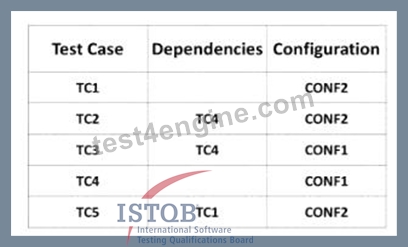
Assume that C0NF1 is the initial configuration of the test environment Based on this assumption, which of the following is a test execution schedule that is compatible with the specified dependencies and allows minimising the number of switches between the different configurations of the test environment^
- A. TC4, TC3, TC2, TC5, TC1.
- B. TCI, TC5, TC4, TC3, TC2
- C. TC4, TC1, TC5, TC2, TC3
- D. TC4, TC3, TC2, TC1, TC5.
Answer: D
Explanation:
To determine the optimal test execution schedule that minimizes the number of configuration switches and respects the dependencies, we start with the initial configuration, CONF1.
* TC4: It has no dependencies and runs on CONF1 (initial configuration).
* TC3: Depends on TC4 and runs on CONF1. Since TC4 is already executed, we can proceed with TC3.
* TC2: Depends on TC4 and runs on CONF2. We switch to CONF2 after TC3.
* TC1: No dependencies and runs on CONF2. Since we are already in CONF2, we can execute TC1 next.
* TC5: Depends on TC1 and runs on CONF2. Since TC1 is already executed, we can proceed with TC5 without additional configuration switches.
By following this sequence (TC4, TC3, TC2, TC1, TC5), we respect the dependencies and minimize the number of configuration switches
NEW QUESTION # 115
A calculator software is used to calculate the result for 5+6.
The user noticed that the result given is 6.
This is an example of;
- A. Fault
- B. Mistake
- C. Failure
- D. Error
Answer: C
Explanation:
According to the ISTQB Glossary of Testing Terms, Version 4.0, 2018, page 18, a failure is "an event in which a component or system does not perform a required function within specified limits". In this case, the calculator software does not perform the required function of calculating the correct result for 5+6 within the specified limits of accuracy and precision. Therefore, this is an example of a failure.
The other options are incorrect because:
* A mistake is "a human action that produces an incorrect result" (page 25). A mistake is not an event, but an action, and it may or may not lead to a failure. For example, a mistake could be a typo in the code, a wrong assumption in the design, or a misunderstanding of the requirement.
* A fault is "a defect in a component or system that can cause the component or system to fail to perform its required function" (page 16). A fault is not an event, but a defect, and it may or may not cause a failure. For example, a fault could be a logical error in the code, a missing specification in the design, or a contradiction in the requirement.
* An error is "the difference between a computed, observed, or measured value or condition and the true, specified, or theoretically correct value or condition" (page 15). An error is not an event, but a difference, and it may or may not result in a failure. For example, an error could be a rounding error in the calculation, a measurement error in the observation, or a deviation error in the condition.
References = ISTQB Glossary of Testing Terms, Version 4.0, 2018, pages 15-18, 25; ISTQB CTFL 4.0 - Sample Exam - Answers, Version 1.1, 2023, Question 96, page 34.
NEW QUESTION # 116
Following a risk-based testing approach you have designed 10 tests to cover a product risk with a high-risk level. You want to estimate, adopting the three-point test estimation technique, the test effort required to reduce the risk level to zero by executing those 10 tests. You made the following three initial estimates:
* most optimistic = 6 person hours
* most likely = 30 person hours
* most pessimistic = 54 person hours
Based only on the given information, which of the following answers about the three-point test estimation technique applied to this problem is true?
- A. The final estimate is exactly 30 person hours because the technique uses the initial most likely estimate as the final estimate
- B. The final estimate is between 6 person hours and 54 person hours
- C. The final estimate is between 22 person hours and 38 person hours
- D. The final estimate is exactly 30 person hours because the technique uses the arithmetic mean of the three initial estimates as the final estimate
Answer: C
Explanation:
The three-point test estimation technique is a method of estimating the test effort based on three initial estimates: the most optimistic, the most likely, and the most pessimistic. The technique uses a weighted average of these three estimates to calculate the final estimate, which is also known as the expected value. The formula for the expected value is:
Expected value = (most optimistic + 4 * most likely + most pessimistic) / 6 Using the given values, the expected value is:
Expected value = (6 + 4 * 30 + 54) / 6 Expected value = 30 person hours However, the expected value is not the only factor to consider when estimating the test effort. The technique also calculates the standard deviation, which is a measure of the variability or uncertainty of the estimates. The formula for the standard deviation is:
Standard deviation = (most pessimistic - most optimistic) / 6
Using the given values, the standard deviation is:
Standard deviation = (54 - 6) / 6 Standard deviation = 8 person hours
The standard deviation can be used to determine a range of possible values for the test effort, based on a certain level of confidence. For example, using a 68% confidence level, the range is:
Expected value ± standard deviation
Using the calculated values, the range is:
30 ± 8 person hours
Therefore, the final estimate is between 22 person hours and 38 person hours, which is option A.
References: ISTQB Certified Tester Foundation Level Syllabus v4.01, Section 2.3.2, page 24-25; ISTQB Glossary v4.02, page 33.
NEW QUESTION # 117
Which of the following is NOT a common objective of testing?
- A. Providing information on the status of the system
- B. Debugging the software to find the reason for defects
- C. Preventing defects
- D. Finding defects in the software
Answer: B
Explanation:
Debugging the software to find the reason for defects is not a common objective of testing, but rather a task of development or maintenance. Debugging is a process of locating and fixing errors in the software code, while testing is a process of finding and reporting defects in the software behavior or quality. Testing does not aim to fix defects, but rather to provide information on their existence and impact. The other options are common objectives of testing. Finding defects in the software is one of the main objectives of testing, as it helps to improve the quality and reliability of the software. Preventing defects is another objective of testing, as it helps to avoid rework and reduce costs and risks. Providing information on the status of the system is another objective of testing, as it helps to support decision making and risk management. Verified Reference: A Study Guide to the ISTQB Foundation Level 2018 Syllabus - Springer, page 3.
NEW QUESTION # 118
In the newest version of payroll system number of changes were made. As a tester you got a task to perform regression and confirmation tests. Which of the following project activities are related to confirmation testing?
- A. Testing if a system still works after update of an operating system
- B. Testing that fixes resolved the defects in the search function
- C. Testing to ensure the adding of a new functionalities haven't broken existing functions
- D. Testing due to the application of a new version of the interface
Answer: B
Explanation:
Confirmation testing, also known as re-testing, is performed to verify that specific defects have been successfully fixed.
Option A: "Testing due to the application of a new version of the interface" would typically involve regression testing, not confirmation testing.
Option B: "Testing that fixes resolved the defects in the search function" fits the description of confirmation testing as it focuses on ensuring that specific issues have been addressed.
Option C: "Testing if a system still works after update of an operating system" is an example of regression testing, as it checks the overall system behavior after an update.
Option D: "Testing to ensure the adding of new functionalities haven't broken existing functions" is another example of re (ISTQB not-for-profit association) (Udemy) it checks for unintended consequences of new changes.
Therefore, the correct answer is B6†source9†source.
References:
* Certified Tester Foundation Level v4.0
* ISTQB Foundation Level Syllabus 4.0 (2023)
NEW QUESTION # 119
Which of the following tools is most likely to detect defects in functions or methods in source code?
- A. unit test framework tool
- B. test design tool
- C. configuration management tool
- D. monitoring tool
Answer: A
Explanation:
A unit test framework tool is a tool that supports the creation, execution, and reporting of unit tests, which are tests that verify the functionality and quality of individual software components (such as functions or methods) in source code. A unit test framework tool can help to detect defects in functions or methods in source code by providing features such as test case generation, test case execution, test result comparison, test coverage measurement, etc. Some examples of unit test framework tools are JUnit, NUnit, TestNG, etc. The other options are not tools that are likely to detect defects in functions or methods in source code. A configuration management tool is a tool that supports the management and control of different versions and variants of software products or components. A test design tool is a tool that supports the design and generation of test cases based on some criteria or rules. A monitoring tool is a tool that monitors the behavior or performance of a system or component under test. Verified Reference: A Study Guide to the ISTQB Foundation Level 2018 Syllabus - Springer, page 10.
NEW QUESTION # 120
A typical objective of testing is to ensure that:
- A. testing is used to drive the development of a software
- B. a software has been tested using a combination of test techniques
- C. a software has been properly covered
- D. there are no defects in a software that is about to be released
Answer: B
Explanation:
This answer is correct because a typical objective of testing is to ensure that a software has been tested using a combination of test techniques, such as black-box, white-box, or experience-based techniques, that are appropriate for the test objectives, test levels, and test types. Testing using a combination of test techniques can increase the effectiveness and efficiency of testing, as different techniques can target different aspects of the software quality, such as functionality, usability, performance, security, reliability, etc. Testing using a combination of test techniques can also reduce the risk of missing defects that could be detected by one technique but not by another. References: ISTQB Foundation Level Syllabus v4.0, Section 2.3.1.1, Section
2.3.2
NEW QUESTION # 121
Which of the following does MOT describe a reason why testing is necessary?
- A. The acquisition of test automation tools was based on the assumption that it will be used m all projects
- B. The customer decided that 100% branch coverage shall be achieved
- C. For avionics and pharmaceutical systems software testing is mandated by standards
- D. The risks associated with delivering the system are far higher than the cost of testing
Answer: A
Explanation:
Testing is necessary for various reasons, such as:
To detect defects and failures that may affect the quality, performance, reliability or security of a software product or system To verify that a software product or system meets its specified requirements, expectations and standards To validate that a software product or system fulfills its intended purpose and satisfies its stakeholders' needs To provide information and feedback about the status and risks of a software product or system To comply with regulations or contractual obligations that mandate testing for certain types of software products or systems The following statements describe some reasons why testing is necessary:
A) The customer decided that 100% branch coverage shall be achieved. This is a reason why testing is necessary, as it reflects a contractual obligation or a quality standard that requires testing to measure and achieve a certain level of code coverage.
C) For avionics and pharmaceutical systems software testing is mandated by standards. This is a reason why testing is necessary, as it reflects a regulation or a compliance requirement that mandates testing for certain types of software products or systems that have high safety or security risks.
D) The risks associated with delivering the system are far higher than the cost of testing. This is a reason why testing is necessary, as it reflects a risk-based approach that considers testing as an investment to reduce the probability and impact of potential failures or defects. The following statement does not describe a reason why testing is necessary:
B) The acquisition of test automation tools was based on the assumption that it will be used m all projects. This is not a reason why testing is necessary, as it reflects a business decision or a resource allocation that does not justify the need or purpose of testing. Test automation tools are not always suitable or beneficial for all projects, and testing can be performed with or without test automation tools. Verified Reference: [A Study Guide to the ISTQB Foundation Level 2018 Syllabus - Springer], Chapter 1, page 5-6.
NEW QUESTION # 122
Which of the following is a factor that contributes to a successful review?
- A. All participants in the review are aware they will be evaluated based on the defects they will find
- B. All participants in the review are trained to deal with the review type and its objectives.
- C. Review metrics must be collected to improve the review process
- D. The author of the work product to be reviewed leads the review meeting.
Answer: B
Explanation:
A successful review process involves all participants being trained in the review type and understanding its objectives. This ensures that everyone can contribute effectively and understand what is expected from the review. Proper training helps to identify defects accurately and facilitates constructive feedback, leading to a more efficient and effective review process. Hence, statement C is correct according to the ISTQB CTFL syllabus.
NEW QUESTION # 123
Consider the followinguser storyand itsacceptance criteria:
User Story:
As a member of the"Agnotoly"association, I want to be able topay the association's dues through an automatic payment methodso that I can forget about payment deadlines.
Acceptance Criteria:
* The member can only pay with'Agnesis Master' credit card.
* The member must register theircell phone number.
* The member must register thecredit cardin the payment system.
* The member must select apayment method (monthly or annual).
* The member mustaccept the terms and conditionsfor the selected method.
* If terms and conditions are accepted, the system sends anOTP(one-time password) to the member's phone for verification.
* The payment method isregistered only after OTP verification.
* Once the payment method is registered, the system will charge on the first business day of the following month.
Test Cycle Results:
* Members successfully paid dues using the credit card.
* Payments were processedmonthly and for over a year.
Which ONE of the following options identifies the acceptance criteria that has NOT been fully covered?
- A. All acceptance criteria have been fully covered during the above test cycle.
- B. Acceptance criteria 8 has not been fully covered during the above test cycle.
- C. Acceptance criteria 4 has not been fully covered during the above test cycle.
- D. Acceptance criteria 6 has not been fully covered during the above test cycle.
Answer: B
Explanation:
Comprehensive and Detailed In-Depth Explanation:Acceptance criteria8states thatthe system should charge the user on the first business day of the following month. However, thetest cycle only verified monthly payments for over a year, without confirming whether payments were processedspecifically on the first business day.
* (B) is incorrectbecause the test validatedmonthly and annual payment options.
* (C) is incorrectbecause not all criteria were fully validated.
* (D) is incorrectbecause OTP verification (6) was tested as part of registration.
Ensuringtimely execution of payments(Criteria 8) requires additional validation.
NEW QUESTION # 124
Which of the following lists factors That contribute to PROJECT risks?
- A. poor software quality characteristics; software does not perform its intended functions.
- B. skill and staff shortages; software does not perform its intended functions; problems in defining the right requirements.
- C. problems in defining the right requirements; contractual issues; poor software quality characteristics.
- D. skill and staff shortages; problems in defining the right requirements, contractual issues.
Answer: D
NEW QUESTION # 125
A new web app aims at offering a rich user experience. As a functional tester, you have run some functional tests to verify that, before releasing the app, such app works correctly on several mobile devices, all of which are listed as supported devices within the requirements specification. These tests were performed on stable and isolated test environments where you were the only user interacting with the application. All tests passed, but in some of those tests you observed the following issue: on some mobile devices only, the response time for two web pages containing images was extremely slow.
Based only on the given information, which of the following recommendation would you follow?
- A. You should not open any defect report and inform the test manager that the devices on which you observed the issue should no longer be supported so that they will be removed from the requirements specification
- B. The issue is related to performance efficiency, not functionality. Thus, as a functional tester, you should not open any defect report as all the functional tests passed
- C. You should not open any defect report as the problem is most likely due to poor hardware equipment on the devices where you observed the issue
- D. You should open a defect report providing detailed information on which devices and by running which tests you observed the issue
Answer: D
Explanation:
As a functional tester, you should open a defect report providing detailed information on which devices and by running which tests you observed the issue. A defect report is a document that records the occurrence, nature, and status of a defect detected during testing, and provides information for further investigation and resolution. A defectreport should include relevant information such as the defect summary, the defect description, the defect severity, the defect priority, the defect status, the defect origin, the defect category, the defect reproduction steps, the defect screenshots, the defect attachments, etc. Opening a defect report is a good practice for any tester who finds a defect in the software system, regardless of the type or level of testing performed. The other options are not recommended, because:
* The issue is related to performance efficiency, not functionality, but that does not mean that as a functional tester, you should not open any defect report as all the functional tests passed. Performance efficiency is a quality characteristic that measures how well the software system performs its functions under stated conditions, such as the response time, the resource utilization, the throughput, etc.
Performance efficiency is an important aspect of the user experience, especially for web applications that run on different devices and networks. Even if the functional tests passed, meaning that the software system met the functional requirements, the performance issue observed on some devices could still affect the user satisfaction, the usability, the reliability, and the security of the software system. Therefore, as a functional tester, you have the responsibility to report the performance issue as a defect, and provide as much information as possible to help the developers or the performance testers to investigate and resolve it.
NEW QUESTION # 126
......
Latest ISTQB-CTFL Exam Dumps - Valid and Updated Dumps: https://actualtests.test4engine.com/ISTQB-CTFL-real-exam-questions.html