


Instant Download PCCSE Dumps Q&As Provide PDF&Test Engine
Fast Exam Updates PCCSE dumps with PDF Test Engine Practice
Palo Alto Networks PCCSE (Prisma Certified Cloud Security Engineer) Certification Exam is a comprehensive assessment designed to test the skills and expertise of cloud security professionals. PCCSE exam is focused on verifying the candidate's knowledge of the latest cloud security technologies and practices, as well as their ability to design and implement effective security measures in complex cloud environments.
NEW QUESTION # 96
A customer is deploying Defenders to a Fargate environment It wants to understand the vulnerabilities in the images it is deploying. How should the customer automate vulnerability scanning for images deployed to Fargate?
- A. Embed a Fargate Defender to automatically scan for vulnerabilities
- B. Set up a vulnerability scanner on the registry
- C. Use Cloud Compliance to identify misconfigured AWS accounts
- D. Designate a Fargate Defender to serve a dedicated image scanner
Answer: A
NEW QUESTION # 97
Given the following information, which twistcli command should be run if an administrator were to exec into a running container and scan it from within using an access token for authentication?
* Console is located at https://prisma-console.mydomain.local
* Token is: TOKEN_VALUE
* Report ID is: REPORTJD
* Container image running is: myimage:latest
- A. twistcli images scan --console-address https://prisma-console.mydomain.local --auth-token TOKEN_VALUE -containerized -vulnerability-details REPORT_ID
- B. twistcli images scan -address https://prisma-console.mydomain.local -token TOKEN_VALUE -containerized --details REPORT_ID
- C. twistcli images scan --address https://prisma-console.mydomain.local -token TOKENVALUE -containerized -details myimage:latest
- D. twistcli images scan -console-address https://prisma-console.mydomain.local -auth-token MY_TOKEN -local-scan -details myimage:latest
Answer: D
Explanation:
The twistcli command for scanning images within Prisma Cloud requires specifying the console address, an authentication token, and the target for the scan. Option B correctly formats the command with --console-address to specify the Prisma Cloud console URL, --auth-token for the authentication token, and --local-scan to indicate that the scan is being performed from within a container. The --details flag followed by the image name (myimage:latest) specifies the target image for the scan. The option --containerized is not necessary as the --local-scan already implies scanning within a container environment. Therefore, Option B is the most accurate and valid command based on the given information.
NEW QUESTION # 98
An administrator has been tasked with creating a custom service that will download any existing compliance report from a Prisma Cloud Enterprise tenant.
In which order will the APIs be executed for this service?
(Drag the steps into the correct order of occurrence, from the first step to the last.)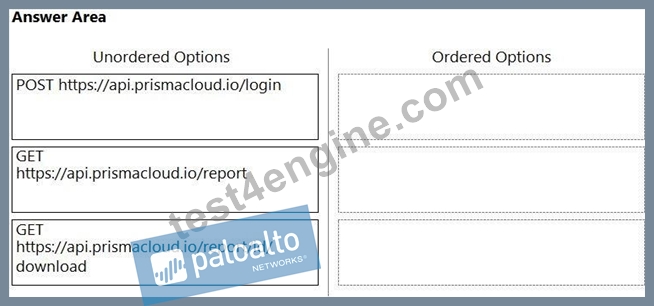
Answer:
Explanation: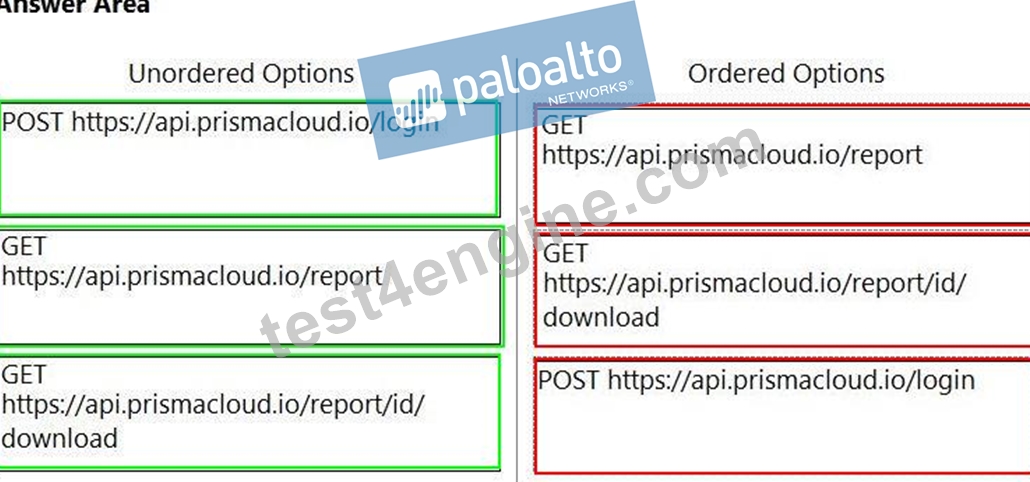
NEW QUESTION # 99
A customer wants to harden its environment from misconfiguration
Prisma Cloud Compute Compliance enforcement for hosts covers which three options? (Choose three.)
- A. Host cloud provider tags
- B. Docker daemon configuration
- C. Docker daemon configuration files
- D. Host configuration
- E. Hosts without Defender agents
Answer: C,D,E
NEW QUESTION # 100
A S3 bucket within AWS has generated an alert by violating the Prisma Cloud Default policy "AWS S3 buckets are accessible to public" The policy definition follows:
config where cloud type = 'aws' AND api name='aws-s3api-get-bucket-acr AND json.rule="((((acl grants{?(@ grantee='AllUsers')] size > 0) or policyStatusisPubiic is true) and publicAccessBlockConfiguration does not exist) or ((ad.grantsp(@ grantee=='AII Users')] size > 0) and publicAccessBlockConfiguration ignorePubhcAds is false) or (policyStatus isPublic is true and publicAccessBlockConfiguration.restrictPublicBuckets is false)) and websiteConfiguration does not exist" Why did this alert get generated?
- A. network traffic to the S3 bucket
- B. anomalous behaviors
- C. configuration of the S3 bucket
- D. an event within the cloud account
Answer: B
NEW QUESTION # 101
The security team wants to protect a web application container from an SQLi attack. Which type of policy should the administrator create to protect the container?
- A. Compliance
- B. Runtime
- C. CNAF
- D. CNNF
Answer: C
NEW QUESTION # 102
Match the service on the right that evaluates each exposure type on the left.
(Select your answer from the pull-down list. Answers may be used more than once or not at all.)
Answer:
Explanation: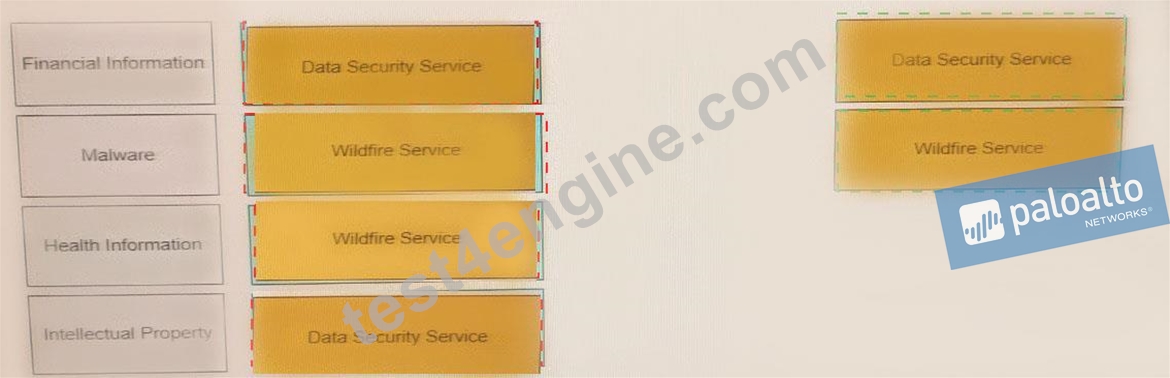
NEW QUESTION # 103
An administrator sees that a runtime audit has been generated for a Container. The audit message is "DNS resolution of suspicious name wikipedia.com. type A".
Why would this message appear as an audit?
- A. The DNS was not learned as part of the Container model or added to the DNS allow list.
- B. The process calling out to this domain was not part of the Container model.
- C. This is a DNS known to be a source of malware.
- D. The Layer7 firewall detected this as anomalous behavior.
Answer: A
Explanation:
The runtime audit message indicating "DNS resolution of suspicious name wikipedia.com. type A" would appear as an audit because the DNS was not learned as part of the Container model or added to the DNS allow list (option A). In cloud security platforms like Prisma Cloud, runtime protection policies monitor the behavior of running containers and compare it against a learned model of expected behavior. If a container attempts to resolve a DNS name that was not observed during the learning phase or specifically allowed, it triggers an audit event to alert security teams of potentially malicious activity.
NEW QUESTION # 104
Which order of steps map a policy to a custom compliance standard?
(Drag the steps into the correct order of occurrence, from the first step to the last.)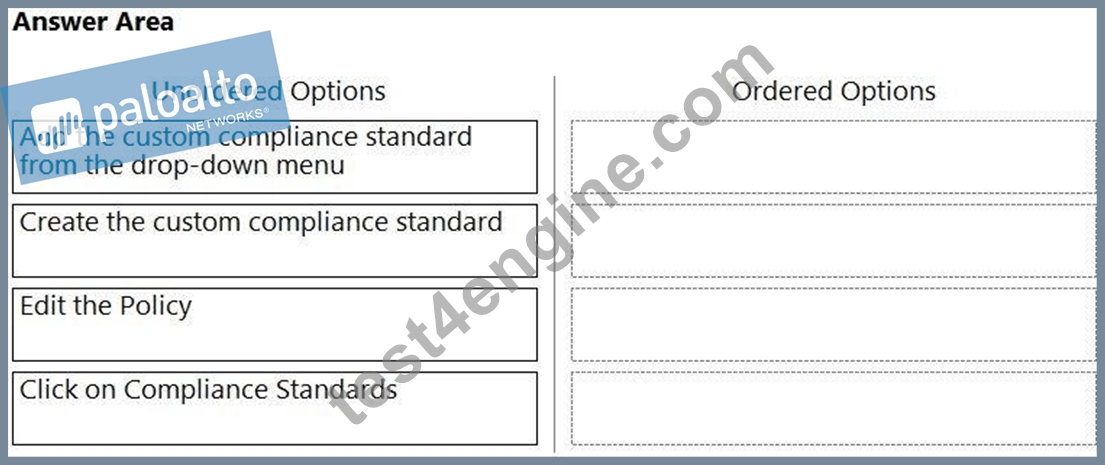
Answer:
Explanation: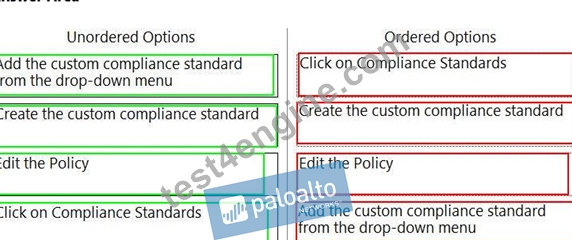
NEW QUESTION # 105
Which intensity setting for anomaly alerts is used for the measurement of 100 events over 30 days?
- A. High
- B. Medium
- C. Low
- D. Very High
Answer: B
NEW QUESTION # 106
A customer has a requirement to terminate any Container from image topSecret:latest when a process named ransomWare is executed.
How should the administrator configure Prisma Cloud Compute to satisfy this requirement?
- A. choose "copy into rule" for the Container, add a ransomWare process into the denied process list, and set the action to "block".
- B. set the Container model to relearn and set the default runtime rule to prevent for process protection.
- C. set the Container model to manual relearn and set the default runtime rule to block for process protection.
- D. add a new runtime policy targeted at a specific Container name, add ransomWare process into the denied process list, and set the action to "prevent".
Answer: A
NEW QUESTION # 107
An administrator needs to detect and alert on any activities performed by a root account.
Which policy type should be used?
- A. config-build
- B. config-run
- C. network
- D. audit event
Answer: C
NEW QUESTION # 108
An administrator wants to enforce a rate limit for users not being able to post five (5) .tar.gz files within five (5) seconds.
What does the administrator need to configure?
- A. A ban for DoS protection with an average rate of 5 and file extensions match on .tar.gz on WAAS
- B. A ban for DoS protection with a burst rate of 5 and file extensions match on .tar gz on WAAS
- C. A ban for DoS protection with an average rate of 5 and file extensions match on .tar.gz on CNNF
- D. A ban for DoS protection with a burst rate of 5 and file extensions match on .tar.gz on CNNF
Answer: A
Explanation:
To enforce a rate limit for users posting .tar.gz files, the administrator needs to configure a ban for Denial of Service (DoS) protection with an average rate of 5 and match file extensions on .tar.gz on the Web Application and API Security (WAAS) system. This ensures that if the specified rate is exceeded, the action is blocked, thus providing protection against potential DoS attacks.
NEW QUESTION # 109
You are tasked with configuring a Prisma Cloud build policy for Terraform. What type of query is necessary to complete this policy?
- A. YAML
- B. Terraform
- C. CloudFormation
- D. JSON
Answer: B
Explanation:
When configuring a Prisma Cloud build policy specifically for Terraform, the type of query necessary is Terraform. Terraform is an infrastructure as code (IaC) tool that allows users to define and provision cloud infrastructure using a declarative configuration language. Prisma Cloud can analyze Terraform templates to identify potential security risks and misconfigurations before the infrastructure is provisioned, aligning with the best practices for integrating security into the application development pipeline and ensuring secure cloud configurations from the start.
NEW QUESTION # 110
Which statement accurately characterizes SSO Integration on Prisma Cloud?
- A. An administrator who needs to access the Prisma Cloud API can use SSO after configuration.
- B. An administrator can configure different Identity Providers (IdP) for all the cloud accounts that Prisma Cloud monitors.
- C. Okta, Azure Active Directory, PingID, and others are supported via SAML.
- D. Prisma Cloud supports IdP initiated SSO, and its SAML endpoint supports the POST and GET methods.
Answer: C
Explanation:
Prisma Cloud supports Single Sign-On (SSO) integration through Security Assertion Markup Language (SAML), enabling users to authenticate using their existing identity providers (IdPs) such as Okta, Azure Active Directory, PingID, among others. This SSO integration allows for a seamless user authentication experience, where users can log in to Prisma Cloud using their credentials managed by their organization's IdP. The SAML protocol facilitates this by allowing secure exchange of authentication and authorization data between the IdP and Prisma Cloud.
This integration enhances security by centralizing user authentication, reducing the number of passwords users need to remember, and enabling organizations to enforce their security policies, such as multi-factor authentication (MFA) and password complexity, across their cloud security tools. SAML support is a common feature in cloud security platforms for integrating with various IdPs, making it a verified approach for Prisma Cloud as well.
NEW QUESTION # 111
In which Console menu would an administrator verify whether a custom compliance check is failing or passing?
- A. Monitor > Compliance
- B. Defend > Compliance
- C. Custom > Compliance
- D. Container Security > Compliance
Answer: A
Explanation:
In Prisma Cloud, the "Monitor > Compliance" menu is the centralized location where administrators can verify the status of custom compliance checks, along with predefined compliance standards and frameworks. This section provides a comprehensive view of the organization's compliance posture, displaying whether specific compliance checks are passing or failing. It allows for detailed insights into compliance status across cloud environments, helping administrators identify areas of non-compliance, understand the reasons behind compliance failures, and take corrective actions to address any identified issues.
NEW QUESTION # 112
What is required for Prisma Cloud to successfully execute auto-remediation commands?
- A. Write access to the cloud platform
- B. Read access to the cloud platform
- C. Access to the cloud platform only for Azure
- D. Prisma Cloud requires no access to the cloud platform
Answer: A
Explanation:
For Prisma Cloud to execute auto-remediation commands, it requires write access to the cloud platform. This is because auto-remediation involves making changes to configurations or settings within the cloud environment to rectify security issues. Thus, the correct answer is B: Write access to the cloud platform.
NEW QUESTION # 113
Per security requirements, an administrator needs to provide a list of people who are receiving e-mails for Prisma Cloud alerts.
Where can the administrator locate this list of e-mail recipients?
- A. Notification Template section within Alerts.
- B. Set Alert Notification section within an Alert Rule.
- C. Users section within Settings.
- D. Target section within an Alert Rule.
Answer: D
NEW QUESTION # 114
A customer is reviewing Container audits, and an audit has identified a cryptominer attack. Which three options could have generated this audit? (Choose three.)
- A. Common cryptominer process name was found.
- B. Common cryptominer port usage was found.
- C. The mined currency is associated with a user token.
- D. High CPU usage over time for the container is detected.
- E. The value of the mined currency exceeds $100.
Answer: A,B,D
Explanation:
In the case of identifying a cryptominer attack through container audits, the options that could have generated this audit include B. High CPU usage over time for the container is detected, which is a common indicator of cryptomining activity as it consumes significant computational resources, C. Common cryptominer process name was found, which directly indicates the presence of cryptomining based on known malicious processes, and E. Common cryptominer port usage was found, suggesting cryptomining activity based on network behavior typical of such attacks.
NEW QUESTION # 115
......
The PCCSE certification is a valuable credential for cloud security professionals who work with Prisma solutions. It demonstrates their expertise in securing cloud environments and protecting digital assets from cyber threats. By passing the PCCSE exam, candidates can showcase their skills and knowledge to employers and clients, and enhance their career prospects in the rapidly growing field of cloud security.
Exam Valid Dumps with Instant Download Free Updates: https://actualtests.test4engine.com/PCCSE-real-exam-questions.html