


Give Push to your Success with CCNP Enterprise 300-425 Exam Questions
300-425 100% Guarantee Download 300-425 Exam PDF Q&A
Cisco 300-425 exam is a computer-based exam that consists of 60-70 multiple-choice and simulation questions. 300-425 exam is designed to test the candidate's abilities in designing and implementing complex wireless networks. 300-425 exam is administered by Pearson VUE and can be taken at any Pearson VUE testing center. 300-425 exam fee is $400 and the exam duration is 90 minutes.
Cisco 300-425 exam is a vendor-neutral exam that is ideal for professionals who want to demonstrate their knowledge of wireless networking technologies. 300-425 exam is intended for network designers, engineers, and architects who are responsible for designing, deploying and managing complex wireless networks. 300-425 exam is also suitable for professionals who are involved in troubleshooting and optimizing wireless networks.
NEW QUESTION # 97
When a wireless survey is conducted at a customer facility, signal attenuation in an area that is surrounded by thick glass walls is noted as 2dB. When Cisco Prime Infrastructure is configured, which obstacle must be placed in a map editor to represent the impact that the glass wall will have on the RF signal in the facility?
- A. thick wall
- B. heavy door
- C. light wall
- D. glass
Answer: C
Explanation:
Thick wall - 13 dB
Light wall - 2 dB
Heavy door - 15 dB
Light door - 4 dB
Glass - 1.5 dB
https://www.cisco.com/c/en/us/td/docs/net_mgmt/prime/network_control_system/1-
2/user/guide/prime_ncs_ug/create_maps.html
NEW QUESTION # 98
An engineer has deployed a group of APs in an auditorium and notices that the APs are showing high cochannel interference. Which profile can be used to adjust the parameters for these high-density APs?
- A. QoS profile
- B. RF profile
- C. ISE profile
- D. AVC profile
Answer: B
Explanation:
NEW QUESTION # 99
A network engineer is working on a predictive WLAN design. The new wireless network must support access to internet, email, voice, and the inventory database To successfully support these services, which configuration must the engineer use for the signal strength levels and SNR on the planning tool?
- A. signal strength of -67 dBm. 20-dB SNR. and maximum 5 percent packet loss
- B. signal strength of 67 dBm. 20-dB SNR and maximum 1 percent packet loss
- C. signal strength of -67 dBm. 25-dB SNR. and maximum 1 percent packet loss
- D. signal strength of -70 dBm. 30-dB SNR. and maximum 10 percent packet loss
Answer: C
Explanation:
https://www.cisco.com/c/en/us/support/docs/wireless/5500-series-wireless-controllers/116057-site-survey-guidelines-wlan-00.html
NEW QUESTION # 100
What is the recommended cell overlap when designing a wireless network for Cisco Hyperlocation?
- A. 20%
- B. 30%
- C. 40%
- D. 50%
Answer: A
Explanation:
NEW QUESTION # 101
An engineer must speed up the reauthentication delays that are being experienced on the wireless infrastructure by deploying a key-caching mechanism. Which mechanism must be configured?
- A. GTK-randomization
- B. FT
- C. PMF
- D. PEAP
Answer: B
Explanation:
Fast Transition (FT), also known as IEEE 802.11r, is the key-caching mechanism that must be configured to speed up the reauthentication delays on the wireless infrastructure. FT allows for rapid re-authentication when roaming between access points, reducing the time required for re-establishing security keys and thus speeding up the overall process2.
References: CCNP Enterprise Wireless Design ENWLSD 300-425 and Implementation ENWLSI 300-430 Official Cert Guide Premium Edition and Practice.
NEW QUESTION # 102
A network engineer is working on a design for a wireless network that must support data, voice, and location services. To support these services, which access point placement must the engineer use?
- A. indoor and outdoor
- B. perimeter and corner
- C. corner only
- D. perimeter only
Answer: D
NEW QUESTION # 103
A network engineer is working on a design for a wireless network that must support data, voice, and location services. To support these services, which access point placement must the engineer use?
- A. indoor and outdoor
- B. perimeter and corner
- C. corner only
- D. perimeter only
Answer: D
Explanation:
Section: Wired and Wireless Infrastructure
NEW QUESTION # 104
A wireless engineer is using Ekahau site survey to validate that an existing wireless network is operating as expected, which type of survey should be using to identify the end-to-end network performance?
- A. Passive
- B. Active ping
- C. Spectrum analysis
- D. GPS assisted
Answer: B
Explanation:
An active ping survey is used to validate network performance by sending and receiving data packets to measure the end-to-end network performance, including latency, packet loss, and throughput. Ekahau site survey tools can perform active ping surveys to test the connectivity and performance of the wireless network, ensuring that it operates as expected and meets the required service levels.
NEW QUESTION # 105
Refer to the exhibit. An engineer is about to establish a mobility peer connection between a Cisco Catalyst 9800-CL version 16.10.1e and Cisco AireOS 5520 version 8.8.120.0. The data path between the 9800-CL and AireOS 5520 is down, but its control path is up. Based on the configuration, what is the cause of the issue?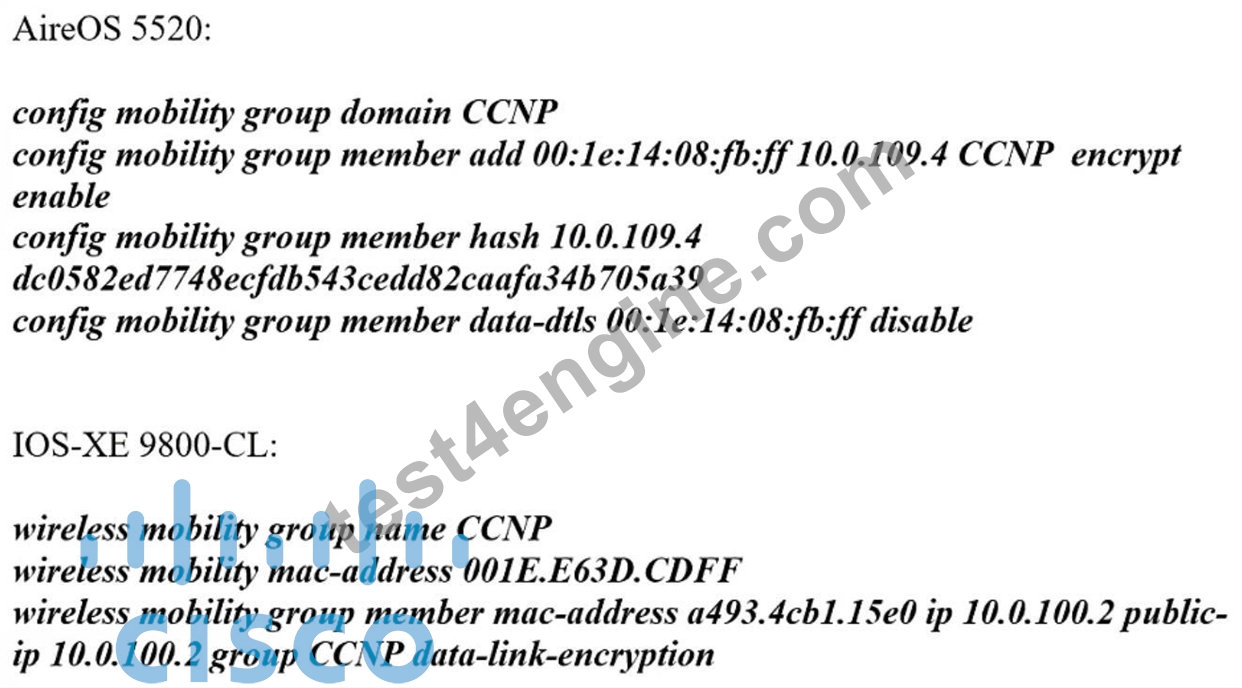
- A. The certificate hash key is incorrect, which causes the data path to be down.
- B. The data-dtls is disabled on the AireOS 5520 WLC, which causes the data path to be down.
- C. The data-link-encryption configuration is missing from the 9800-CL configuration.
- D. Encrypted mobility is being used in the 5520 configuration, which causes the data path to be down.
Answer: B
NEW QUESTION # 106
Guest anchoring is configured for a newly created SSID for your company. It has been noticed that the mobility tunnels are not up, and that MPING fails from your foreign WLC to the anchor WLC. What is the reason that it is failing?
- A. A rule is needed at the firewall to allow TCP port 16666 for communication to work.
- B. A rule is needed at the firewall to allow UDP port 16666 for communication to work.
- C. A rule is needed at the firewall to allow TCP port 97 for communication to work.
- D. A rule is needed at the firewall to allow UDP port 97 for communication to work.
Answer: B
Explanation: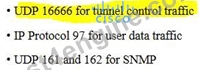
NEW QUESTION # 107
An enterprise has moved most services to the cloud, including email applications and real-time communication.
Which feature must be enabled on the wireless network to improve the user experience?
- A. fast secure roaming
- B. QoS
- C. radio management
- D. interference mitigation
Answer: A
Explanation:
https://www.cisco.com/c/en/us/td/docs/wireless/controller/8-5/Enterprise-Mobility-8-5- DesignGuide/Enterprise_Mobility_8-5_Deployment_Guide.pdf
NEW QUESTION # 108
An engineer must speed up the reauthentication delays that are being experienced on the wireless infrastructure by deploying a key-caching mechanism. Which mechanism must be configured?
- A. GTK-randomization
- B. FT
- C. PMF
- D. PEAP
Answer: B
Explanation:
Fast Transition (FT), also known as IEEE 802.11r, is the key-caching mechanism that must be configured to speed up the reauthentication delays on the wireless infrastructure. FT allows for rapid re-authentication when roaming between access points, reducing the time required for re-establishing security keys and thus speeding up the overall process2.
CCNP Enterprise Wireless Design ENWLSD 300-425 and Implementation ENWLSI 300-430 Official Cert Guide Premium Edition and Practice.
NEW QUESTION # 109
A customer requires that two wireless APs be installed in a reception area, in a historic building, the impact of the APs on the appearance of the reception area must be minimized. Which two AP antennas should be used? (Choose two.)
- A. AP with a Yagi antenna
- B. AP with a monopole antenna
- C. AP with a dipole antenna
- D. AP with a patch antenna
- E. AP with an integrated antenna
Answer: D,E
Explanation:
In a historic building where aesthetics are important, using APs with integrated antennas can minimize visual impact as they are often designed to be compact and less conspicuous. Patch antennas are also a good choice as they can be mounted flat against surfaces, blending in with the environment while providing directional coverage.
NEW QUESTION # 110
Which two considerations must a network engineer have when planning for voice over wireless roaming?
(Choose two.)
- A. Roaming occurs when the phone has reached −80 dBs or below.
- B. Roaming time increases when using 802.1x + Cisco Centralized Key Management.
- C. Roaming with only 802.1x authentication requires full reauthentication.
- D. Roaming occurs when the phone has seen at least four APs.
- E. Full reauthentication introduces gaps in a voice conversation.
Answer: C,E
Explanation:
Section: Mobility
NEW QUESTION # 111
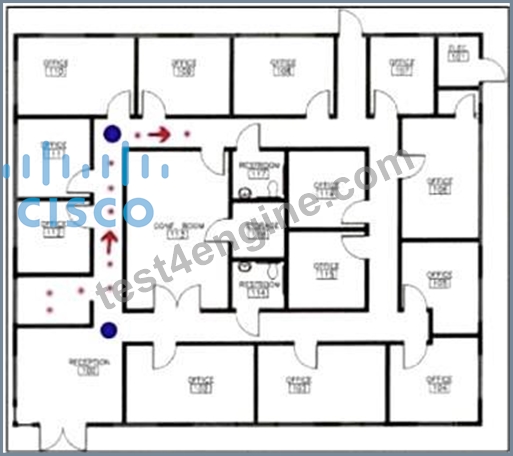
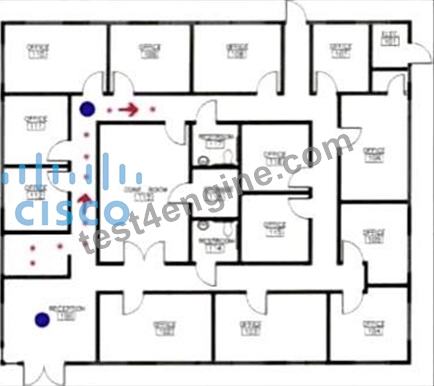
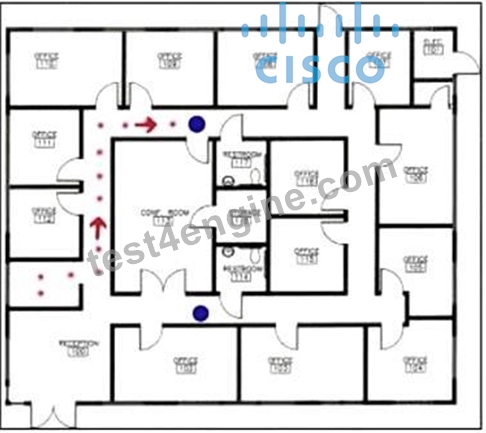
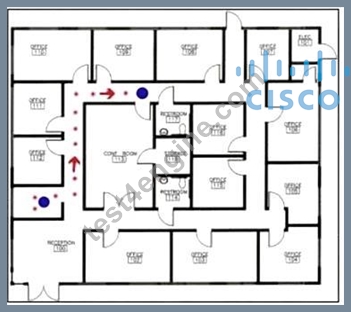
Users who leave the office with a wireless headset must be able to hand off the voice call with minimal disruption. The engineer drafted four possible floor plans for AP placement:
- red dots and arrows represent the direction of travel
- blue dots represent the AP placements
Which floor plan provides the requested functionality?
- A.
- B.
- C.
- D.
Answer: B
NEW QUESTION # 112
Which two factors influence the roaming decision of a wireless client? (Choose two.)
- A. AP transmit power
- B. Access point channel number
- C. Received Signal Strength Indicator (RSSI)
- D. Client's roaming algorithm
- E. Signal-to-Noise Ratio (SNR)
Answer: C,D
NEW QUESTION # 113
A customer has two Cisco 550B WLCs that manage all the access points in their network and provide N+1 redundancy and load balancing. The primary Cisco WLC has 60 licenses and the secondary Cisco WLC has
40. The customer wants to convert the N+1 model to an HA model and provide SSO. Configuration must be performed during a maintenance window. After performing all the configurations on both controllers, the config redundancy unit secondary command is issued on the secondary Cisco WLC and it fails. Which parameter needs to be in place to complete the configuration?
- A. A cable in the RP port
- B. SSO needs to be enabled
- C. The primary Cisco WLC is already set as the secondary unit.
- D. The secondary Cisco WLC needs a minimum of 50 base licenses
Answer: D
Explanation:
NEW QUESTION # 114
Clustering Cisco WLCs into a single RF group enables the RRM algorithms to scale beyond the capabilities of a single Cisco WLC. How many WLC and APs in an RF group can the controller software scale up to in WLC release 8.9 depending on the platform?
- A. up to 20 WLCs and 6000 APs
- B. up to 20 WLCs and 4000 APs
- C. up to 20 WLCs and 1000 APs
- D. up to 20 WLCs and 3000 APs
Answer: D
Explanation:
In Cisco WLC release 8.9, the controller software can scale up to 20 WLCs and 3000 APs within a single RF group. This capability allows the Radio Resource Management (RRM) algorithms to function effectively across a larger network, optimizing the wireless experience by managing the RF environment and resources across multiple controllers and access points.
References: CCNP Enterprise Wireless Design ENWLSD 300-425 and Implementation ENWLSI 300-430 Official Cert Guide Premium Edition and Practice.
NEW QUESTION # 115
An engineer is designing a network deployment for a college with six buildings Each building must have a WLC located in the IDF to support the Aps. The wireless clients should be able to roam between the APs and the controllers. Which type of wireless architecture should be used?
- A. centralized
- B. distributed
- C. cloud
- D. autonomous
Answer: B
Explanation:
https://www.cisco.com/c/en/us/td/docs/solutions/Enterprise/Mobility/emob41dg/emob
41dg-wrapper/ch2_Arch.html
NEW QUESTION # 116
Which two criteria must be considered when conducting an outdoor bridge site survey? (Choose two.)
- A. weather
- B. traffic lights
- C. near-far effect
- D. power lines
- E. Fresnel zone
Answer: A,E
Explanation: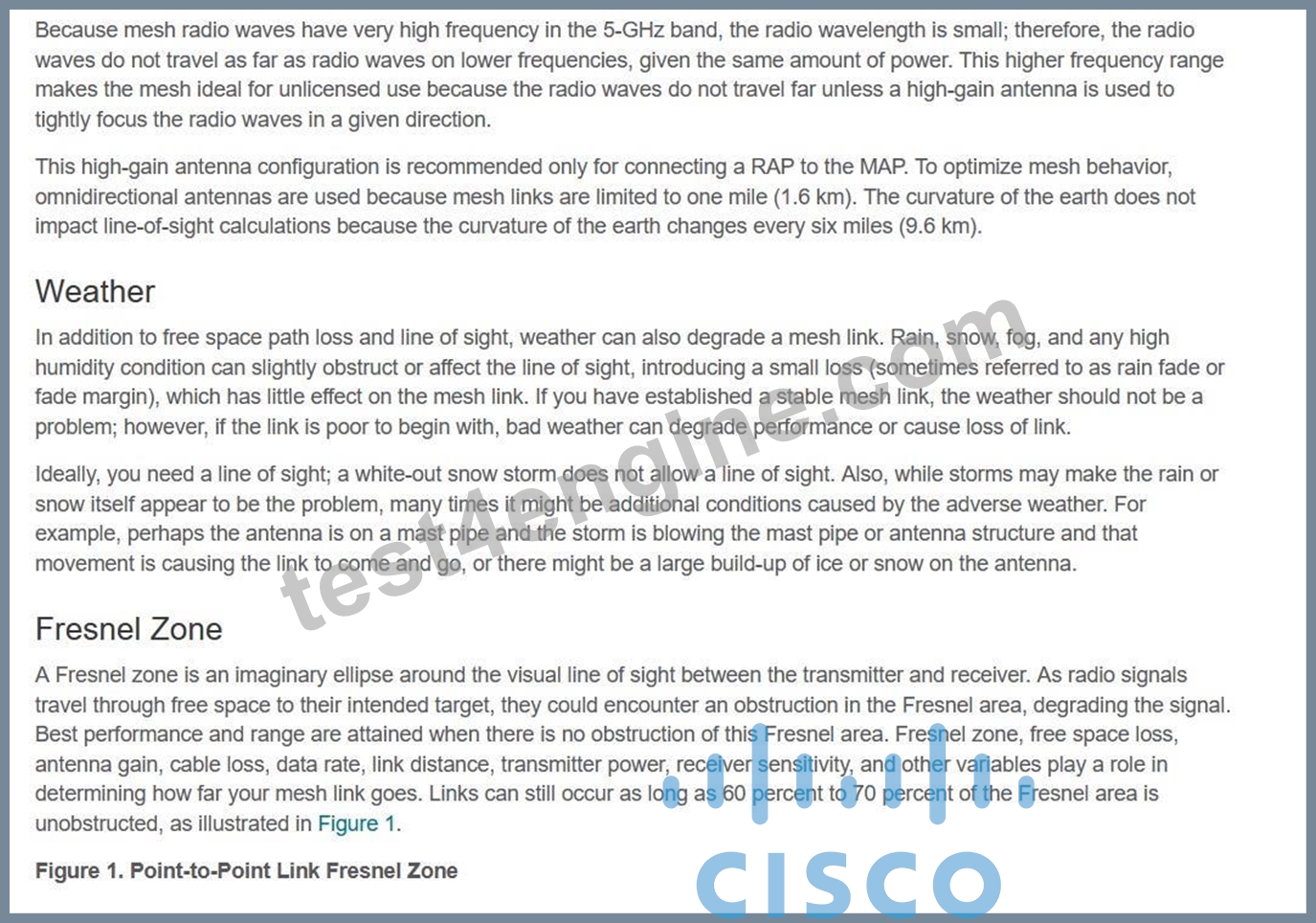
NEW QUESTION # 117
A wireless engineer must optimize RF performance for multiple buildings with multiple types of construction and user density. Which two actions must be taken? (Choose two.)
- A. Configure RF profiles for each area type.
- B. Enable DTPC on the network.
- C. Configure Flexconnect groups for each building.
- D. Configure AP groups for each area type.
- E. Configure WMM profiles for each building.
Answer: A,D
Explanation:
To optimize RF performance across different buildings and user densities: C. Configure AP groups for each area type - This allows for customized settings for APs serving different areas. D. Configure RF profiles for each area type - RF profiles enable the customization of RF parameters to suit the specific needs of each building or area type.
Reference:
https://www.cisco.com/c/en/us/td/docs/wireless/controller/8-10/config-guide/b_cg810/configuring_ap_groups.html
NEW QUESTION # 118
......
Cisco 300-425 exam is a 90-minute test that evaluates your ability to design, configure, and troubleshoot complex enterprise wireless networks. 300-425 exam covers a wide range of topics, including wireless site surveys, wireless infrastructure design, WLAN high availability, and WLAN security implementation. It also focuses on advanced topics such as multicast over wireless, location-based services, and high-density wireless networks.
Get 300-425 Actual Free Exam Q&As to Prepare Certification: https://actualtests.test4engine.com/300-425-real-exam-questions.html